
How to Evaluate Sodium Bentonite for Sale for Large-Scale Construction Projects?
2026-06-29
Selecting the appropriate mineral clay for large-scale industrial projects requires a deep understanding of geological properties and performance metrics. Sodium bentonite, a highly swellable clay mineral consisting primarily of sodium montmorillonite, is a preferred material across diverse sectors including geotechnical engineering, drilling operations, metal casting, and environmental containment. When procurement managers evaluate sodium bentonite for sale, they must look beyond basic pricing to analyze the physical-chemical attributes that dictate performance in the field.
The unique structural characteristics of this clay allow it to expand significantly upon hydration, forming a dense, low-permeability barrier. Jinshi provides high-grade industrial clay products processed to meet rigorous specifications, ensuring that projects maintain structural integrity and operational efficiency. This guide covers the mineralogical details, application scenarios, and procurement considerations that decision-makers must weigh when sourcing bulk shipments.
Mineralogical Composition and Chemical Specifications
The utility of sodium bentonite stems from its crystalline structure, which consists of an octahedral alumina sheet sandwiched between two tetrahedral silica sheets. This three-layer clay mineral exhibits a net negative charge, which is balanced by exchangeable cations in the interlayer spaces. In natural sodium bentonite, these positions are occupied predominantly by sodium ions ($Na^+$) rather than calcium ions ($Ca^{2+}$).
This ionic balance is a fundamental factor in the clay's performance. Because sodium ions have a single charge and a relatively large hydrated radius, they allow water molecules to penetrate the interlayer spaces easily. This hydration process causes the clay platelets to separate, resulting in a volume expansion that can reach up to 15 to 20 times the dry volume of the clay. When looking for sodium bentonite for sale, buyers should verify the mineralogical purity of the product to ensure that montmorillonite content is high enough to deliver these swelling properties.
Typical chemical composition parameters for high-grade industrial clay include:
Silicon Dioxide ($SiO_2$): 54% – 59%
Aluminum Oxide ($Al_2O_3$): 18% – 21%
Iron Oxide ($Fe_2O_3$): 3.2% – 4.5%
Sodium Oxide ($Na_2O$): 1.8% – 2.8%
Calcium Oxide ($CaO$): 1.0% – 1.6%
Loss on Ignition (LOI): 5.5% – 7.5%
These chemical proportions influence the physical properties of the clay. A high concentration of sodium relative to calcium is vital for securing a reliable swelling index. Natural sodium bentonite retains its swelling and sealing capabilities over long-term exposure to hydration cycles, making it superior to chemically modified or "soda-activated" calcium bentonites for applications where long-term durability is required.
Evaluating Performance Criteria in Procurement
Sourcing sodium bentonite for sale requires strict adherence to quality assurance protocols. Suppliers must provide batch test certificates verifying several physical parameters. These parameters directly impact how the clay behaves when mixed with water or other geological materials on-site.
1. Swelling Capacity (Free Swell Index)
The free swell volume is a primary indicator of clay quality. Measured by slowly adding 2.0 grams of dry bentonite to 100 milliliters of distilled water, high-grade clay should yield a settled volume of at least 20 to 24 milliliters. Anything below 16 milliliters typically indicates a high percentage of non-swelling minerals, such as quartz, feldspar, or gypsum, which dilute the product's effectiveness.
2. Viscosity and Fluid Loss
For drilling and tunneling operations, the rheological properties of the clay suspension are paramount. Under American Petroleum Institute (API) Spec 13A guidelines, the clay must meet specific standards for plastic viscosity, yield point, and filtrate loss. A standard 6% bentonite suspension in water must demonstrate a filtrate loss of less than 15 cubic centimeters, ensuring that a thin, low-permeability filter cake is deposited on the borehole wall to prevent fluid loss into surrounding formations.
3. Particle Size Distribution
The rate of hydration and ease of mixing depend on the particle size. For drilling muds and foundry binders, a fine powder (typically 90% passing through a 200-mesh sieve) is required for rapid dispersion. For pond sealing, agricultural applications, and geotechnical liners, coarser granules (ranging from 10 to 50 mesh) are preferred. Coarse granules sink through standing water before hydrating, allowing targeted application at the bed of a water body without dissolving prematurely.
Major Industrial Applications of Sodium Bentonite
The physical-chemical versatility of the clay enables its use across several heavy industries. Understanding how the material functions in each application helps procurement teams specify the correct grade when evaluating sodium bentonite for sale options.
Civil Engineering and Slurry Walls
In deep excavation projects, cut-off walls, and tunneling, bentonite slurries are used as stabilizing fluids. The slurry exerts hydrostatic pressure against the excavation walls, preventing cave-ins before concrete can be poured. The thixotropic nature of the clay suspension—where it behaves as a fluid when agitated but gels when stationary—allows it to suspend heavy drill cuttings during excavation stops, preventing them from settling at the bottom of the shaft.
Pond Sealing and Environmental Containment
Preventing water seepage through porous soils is a major challenge in agricultural water management and industrial waste storage. Incorporating sodium bentonite for sale into sandy or gravelly soils reduces the hydraulic conductivity of the ground. When the clay particles hydrate, they swell and fill the voids between soil particles. This process can reduce the permeability coefficient of a soil layer to less than $1 \times 10^{-8}$ centimeters per second, creating an effective barrier against water loss and pollutant migration.
Metal Casting and Foundry Sand Binder
In green sand molding for iron and steel casting, bentonite serves as a binder to hold the silica sand mold together. The clay must withstand the high temperatures of molten metal without losing its binding capacity. Natural sodium clay is selected for its superior thermal stability and green compression strength, allowing molds to maintain their precise dimensions during the pouring process, which minimizes casting defects.
Pet Care and Clumping Cat Litter
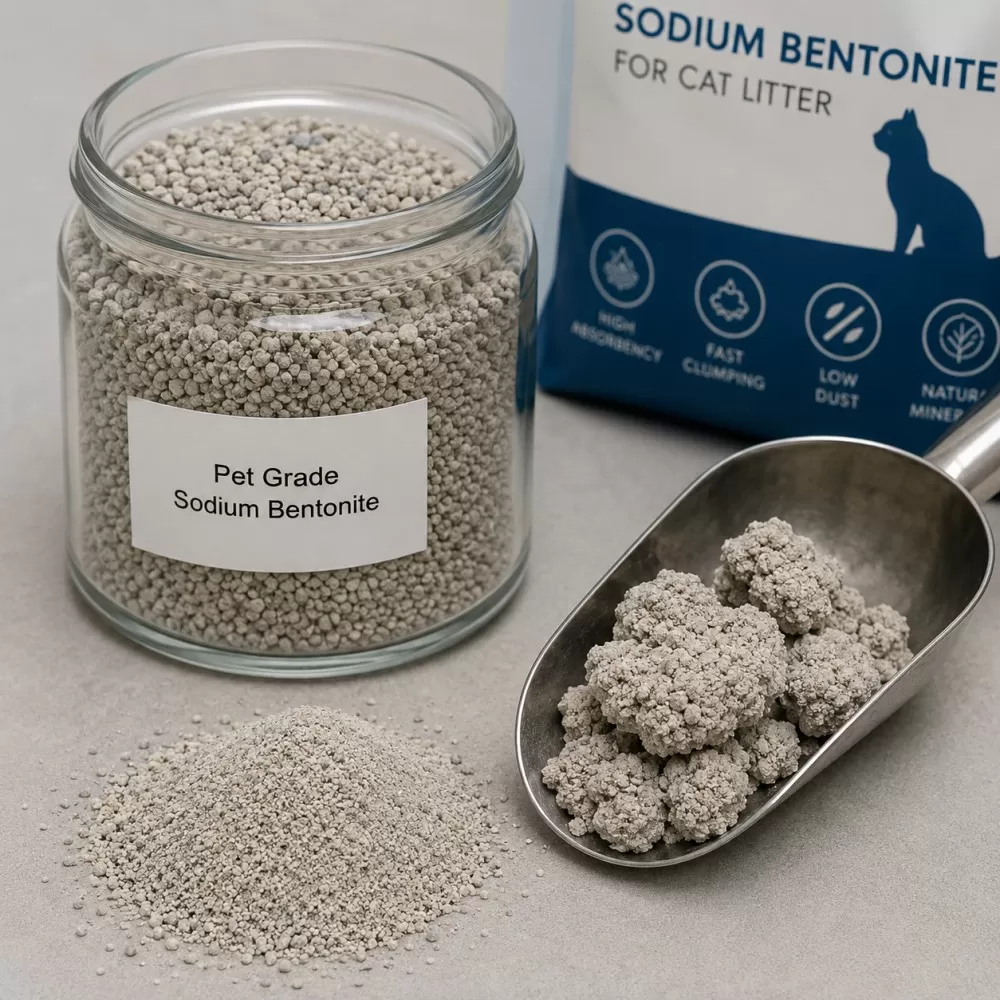
The domestic pet care sector relies heavily on the rapid absorption properties of this clay. High-grade sodium bentonite forms tight, flat clumps when exposed to moisture, making waste removal efficient. The natural molecular structure of the clay also assists in trapping ammonia odors within its interlayer spaces. Jinshi processes customized granular distributions specifically tailored for cat litter manufacturers, ensuring minimal dust generation and optimal clumping strength.
Sourcing Considerations and Quality Control
Sourcing sodium bentonite for sale in bulk quantities involves examining the logistics, processing consistency, and mineral source of the supplier. Industrial projects cannot tolerate high variability between batches, as this leads to unpredictable behavior during mixing and application.
Buyers must distinguish between natural sodium bentonite and sodium-activated calcium bentonite. Sodium-activated clays are produced by treating calcium bentonite with sodium carbonate (soda ash). While these activated clays may initially exhibit high swelling indexes in laboratory tests, the sodium ions are weakly bound. Over time, when exposed to groundwater containing dissolved calcium or magnesium ions, ion exchange can occur, reverting the clay to its low-swelling calcium form and compromising the integrity of environmental barriers.
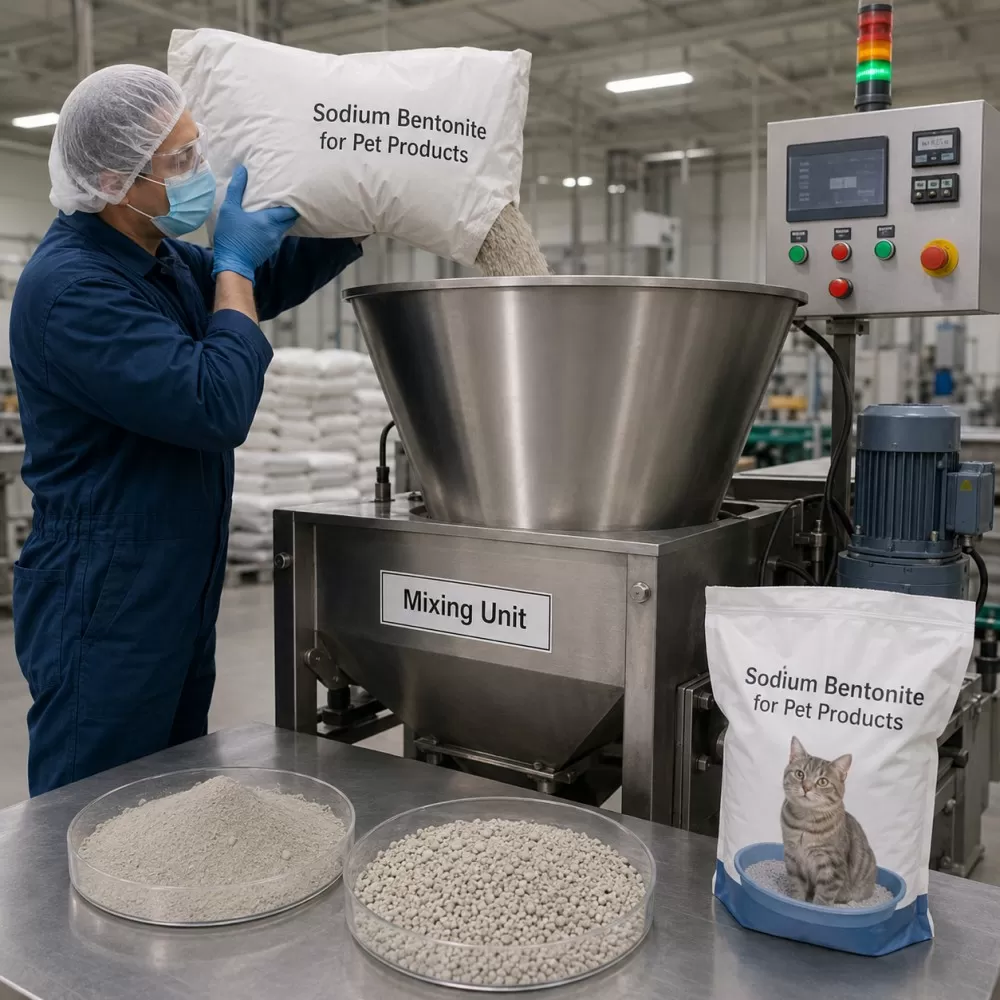
Consistent processing is another area of focus. Jinshi utilizes advanced milling and drying equipment to control moisture levels and particle size distributions. The moisture content of the clay must be maintained within a tight range of 8% to 12%. If the clay is too dry, it can suffer from degraded mineral structures; if it is too wet, it may clumping during storage, leading to handling difficulties in silos and mixing hoppers.
Packaging and Global Logistics
Because sodium bentonite is highly sensitive to ambient humidity, packaging must prevent moisture ingress during transport and storage. Standard packaging configurations include:
Multi-wall paper bags: Typically 25 kg bags, palletized and shrink-wrapped, suitable for manual handling and smaller construction sites.
Jumbo bags (Bulk Bags): 1,000 kg or 1,200 kg woven polypropylene bags with internal plastic liners, designed for mechanical handling at large industrial facilities.
Bulk pneumatically discharged tankers: Best suited for continuous-use industrial processes with dedicated silo storage.
When planning overseas logistics, maritime transport must be managed to avoid exposure to seawater or high humidity, which can initiate pre-hydration. Jinshi manages the supply chain carefully, utilizing dry, secure container shipments and moisture-resistant packaging designs to ensure the material arrives in optimal condition.
Frequently Asked Questions
Q1: What is the primary difference between natural sodium bentonite and sodium-activated bentonite?
A1: Natural sodium bentonite contains sodium ions natively bound within its mineral lattice, offering stable, long-term swelling performance. Sodium-activated bentonite is calcium bentonite chemically treated with soda ash to swap calcium ions for sodium. Activated clays are susceptible to ion reversion over time when exposed to calcium-rich groundwater, which can diminish their swelling capability.
Q2: How much sodium bentonite is required to seal a leaking pond?
A2: The application rate depends on the soil composition. For sandy soils, a rate of 3 to 5 pounds per square foot (approximately 15 to 25 kg per square meter) is generally recommended. Coarse soils with higher gravel content may require up to 8 pounds per square foot to achieve a reliable seal.
Q3: How does moisture content affect the shelf life of bulk bentonite?
A3: Bentonite with a standard moisture content of 8% to 12% can be stored indefinitely, provided it is kept in a dry, covered environment away from direct contact with moisture. If exposed to humid air or water, the clay will begin to hydrate and clump, making it difficult to pump, mix, or disperse.
Q4: Can sodium bentonite be used in saline groundwater conditions?
A4: High concentrations of salt or minerals in water can inhibit the swelling capacity of standard sodium bentonite due to charge suppression in the diffuse double layer. For projects involving saline environments, specially treated or polymer-modified bentonites are required to maintain swelling and sealing properties.
Q5: What standard testing methods should be used to verify the quality of a shipment?
A5: Standard quality verification tests include the Free Swell Test (ASTM D5890) to measure swelling volume, the Fluid Loss Test (API RP 13B-1) to evaluate filtration properties, and moisture content testing by oven drying. X-ray diffraction (XRD) can also be used to confirm the mineralogical purity of the montmorillonite phase.
Submitting an Inquiry to Jinshi
Selecting the appropriate grade of sodium bentonite is critical to the success of your engineering, environmental, or manufacturing project. Our technical team can assist you in reviewing your project specifications, providing detailed material data sheets, and arranging representative samples for laboratory verification. Please contact our sales department with your required volume, particle size preferences, and application details to receive a customized quotation.