
Industrial Sodium Bentonite Clay Uses: Geotechnical & Drilling Engineering Guide
2026-09-05
Sodium bentonite is an absorbent aluminum phyllosilicate clay formed predominantly of the smectite mineral montmorillonite. Geologically derived from altered volcanic ash beds, its industrial performance is dictated by its 2:1 crystal lattice structure: an octahedral alumina sheet sandwiched between two tetrahedral silica sheets. In natural sodium bentonite, monovalent sodium ions (Na⁺) dominate the interlayer spaces.
Because the hydration energy of the monovalent sodium cation is high, water molecules split the interlayer platelets, forcing the crystal lattice to expand. This allows high-grade sodium bentonite to swell 15 to 20 times its original dry volume and generate a dense, semi-permeable thixotropic gel. Understanding these physical-chemical mechanisms is essential for evaluating primary sodium bentonite clay uses across petrochemical exploration, geotechnical engineering, hydraulic containment, and metallurgy.
Mineralogical Mechanics: Why Sodium Bentonite Outperforms Calcium
Variants
The industrial utility of bentonite hinges on whether the exchangeable interlayer cation is sodium or calcium. Calcium bentonite features divalent calcium ions (Ca²⁺) which exert a much stronger electrostatic attraction on adjacent silicate layers. This tight bond suppresses hydration, restricting volumetric expansion to only 2 to 4 times the mineral's dry state.
Hydration & Double-Layer Repulsion: Sodium cations dissociate readily in water, forming a thick diffuse double layer (DDL) around each platelet. The resulting electrostatic repulsion forces platelets apart, creating high colloidal dispersion.
Swell Index (ASTM D5890): High-grade sodium bentonite reliably achieves a swelling capacity of ≥ 24 mL/2g, whereas unactivated calcium bentonite rarely exceeds 8 mL/2g.
Natural vs. Activated Bentonite: While calcium bentonite can undergo chemical activation via sodium carbonate (soda ash) addition to swap Ca²⁺ for Na⁺, naturally occurring sodium bentonite exhibits superior thermal endurance, higher shear strength under cyclic strain, and lower susceptibility to cation back-exchange over extended periods.
Primary Industrial Sodium Bentonite Clay Uses
1. Drilling Fluids for Deep Well Energy Exploration and HDD
In rotary drilling operations for oil, gas, water wells, and horizontal directional drilling (HDD), bentonite operates as the rheological foundation of water-based drilling muds, governed by API Specification 13A guidelines.
Viscosity and Cuttings Transport: Sodium bentonite provides non-Newtonian, pseudoplastic behavior. Under drill string shear, the fluid thins to minimize pumping resistance; when circulation stops, the fluid instantly forms a thixotropic gel with sufficient yield stress to keep dense cuttings suspended, preventing stuck-pipe incidents.
Filter Cake Formation and Wellbore Stabilization: Dispersed colloidal platelets plaster against permeable formations under hydrostatic pressure. They form a low-permeability (sub-millimeter) filter cake that limits fluid loss into surrounding rock strata, stabilizes the borehole wall, and prevents formation collapse.
Tool Cooling and Lubrication: The hydrated clay matrix lubricates the bit-formation interface, dissipating friction-induced heat across extreme drilling depths.
2. Geotechnical Slurry Cut-Off Walls and Underground Support
In deep foundation engineering, civil contractors use sodium bentonite slurries to construct diaphragm walls, barrettes, and bored piles.
Hydrostatic Trench Stabilization: During trench excavation in granular or water-bearing soils, the trench is filled with a bentonite-water slurry (typically 4% to 7% solids). The positive hydrostatic head of the slurry counterbalances soil pore-water pressure.
Membrane Formation (Cake Deposition): The colloidal particles penetrate the porous sidewalls, rapidly bridging pore throats to create an impermeable skin. This enables deep civil excavations to remain open without steel shoring prior to tremie concrete placement.
Pipe Jacking and Microtunneling: Bentonite slurry functions as a pressure-equalizing lubricant injected around the exterior perimeter of the tunnel shield to reduce jacking friction against native soils.
3. Hydraulic Barriers and Containment Liners
Environmental and hydraulic containment represents one of the most critical sodium bentonite clay uses, exploiting the mineral’s ability to reach hydraulic conductivities ($k$) as low as $1 \times 10^{-9} \text{ cm/s}$.
Geosynthetic Clay Liners (GCLs): Engineered GCLs sandwich a uniform layer of granular sodium bentonite between woven and non-woven geotextiles. Deployed beneath municipal solid waste landfills and industrial holding basins, hydrated sodium bentonite prevents hazardous leachate from entering local aquifers.
Pond, Canal, and Lagoon Sealing: For municipal or agricultural impoundments built in sandy or permeable substrate, sodium bentonite is incorporated into the soil via the blanket method (3 to 5 lbs/sq. ft., mechanically blended and compacted into the upper 6 inches). As water enters, the clay particles hydrate and swell into voids, forming an impermeable, self-healing floor.
Infrastructure Waterproofing: Sodium bentonite boards and composite rolls installed beneath below-grade foundation slabs expand when exposed to perimeter groundwater, self-sealing hairline concrete cracks and structural seams against hydrostatic head pressure.
4. Foundry Sand Binding and Iron Ore Pelletization
Beyond fluid applications, sodium bentonite serves as an inorganic binder under high temperatures and compressive stresses.
Green Sand Casting: In metal foundries, sodium bentonite is mixed with silica sand and minimal water to form green sand molds. The clay provides high green compression strength to preserve mold geometry during pattern removal, as well as dry and hot strength to withstand the thermal shock of molten steel or iron without casting erosion.
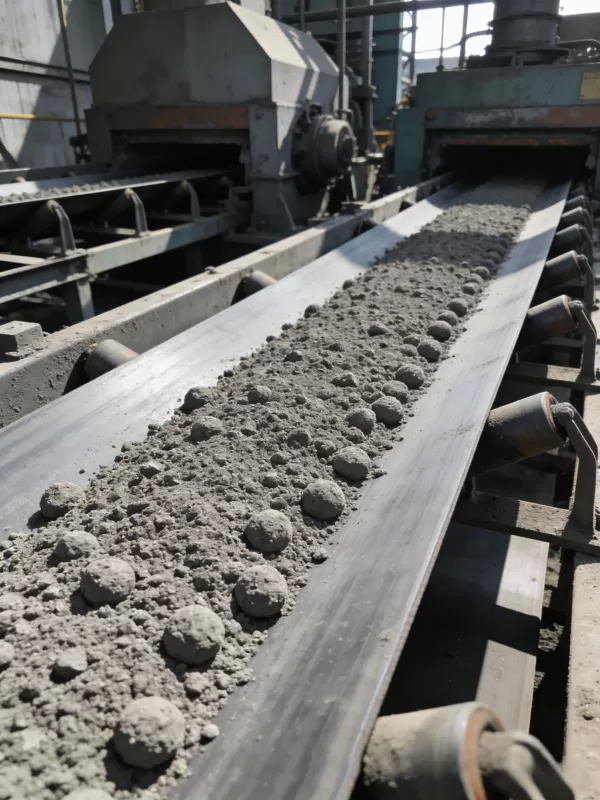
Iron Ore Agglomeration: In steel manufacturing, microscopic iron ore concentrate particles cannot be added directly into a blast furnace without choking gas permeability. Adding 0.5% to 0.8% ultra-fine sodium bentonite allows dust to ball into uniform green pellets that maintain structural integrity through handling, drying, and high-heat firing cycles.
Technical Constraints: Mitigating Salinity and Electrolyte Vulnerability
Deploying sodium bentonite in demanding field conditions requires an understanding of its operating thresholds:
Cation Exchange Suppression: Divalent and trivalent cations ($Ca^{2+}, Mg^{2+}, Fe^{3+}$) present in hard water, seawater, or industrial waste streams exchange with the sodium ions in the clay lattice. This compresses the diffuse double layer, causing flocculation, loss of swelling index, and sharp increases in hydraulic conductivity.
Salinity Sensitivity: In drilling operations encountering salt formations or seawater, standard sodium bentonite muds aggregate and drop their viscosity. In these settings, polymer-treated bentonite, synthetic rheology modifiers, or attapulgite clays must be integrated to prevent fluid degradation.
Desiccation and Hydration Cycling: In containment zones subject to prolonged drying periods, the bentonite matrix will desiccate and develop structural shrinkage cracks. While high-grade natural sodium bentonite self-heals upon re-hydration under adequate confinement, unconfined installations may require engineered geotextile caps to preserve baseline saturation.
Quality Assurance Metrics for Commercial Sodium Bentonite Procurement
Specifying engineers and procurement teams must verify that bulk sodium bentonite lots are supported by a Certificate of Analysis (COA) confirming adherence to standard physical metrics:
API 13A Compliance: For drilling applications, verify a Yield Point/Plastic Viscosity (YP/PV) ratio aligned with engineering specifications, a filtrate loss below 15.0 cm³, and a minimum suspension yield of 90 barrels per ton.
Free Swell Volume (ASTM D5890): Geotechnical and waterproofing applications require values equal to or exceeding 24 mL per 2 grams of dry clay.
Fluid Loss Properties (ASTM D5891): GCL components should display fluid loss below 18.0 mL at standard test pressures.
Montmorillonite Purity: Quantified using the Methylene Blue Index (ASTM C837), industrial-grade sodium bentonite should exhibit high smectite content to avoid buying inactive quartz, feldspar, or cristobalite fillers.
Producers such as Jinshi supply precision-milled, rigorously graded sodium bentonite products processed to tight tolerances for particle sizing (from coarse granules to 200-mesh powders), ensuring rapid hydration, consistent yield points, and predictable filtration control across demanding sites.
Procurement and Technical Supply with Jinshi
Procuring industrial clay for geotechnical shoring, oilfield operations, or civil containment demands strict adherence to chemical specifications. Inconsistent swell indices or elevated silica contents disrupt slurry rheology and compromise hydraulic seals.
Jinshi manufactures and exports high-grade sodium bentonite engineered for international civil engineering and energy projects. With verified API-grade certifications, strict ASTM-standard lot tracking, and reliable logistics for bulk vessel, breakbulk, and containerized distribution, Jinshi provides technical supply chain reliability for large operations. Contact the Jinshi technical sales department today to request comprehensive Product Data Sheets (PDS), batch-specific COAs, or lab samples for your next project.
Frequently Asked Questions
What makes sodium bentonite self-healing in civil waterproofing?
Sodium bentonite swells between 15 and 20 times its dry volume when hydrated. When confined between concrete surfaces or under soil backfill, the swelling clay cannot expand freely. Instead, it generates swelling pressure that drives dense, gelled montmorillonite platelets directly into adjacent voids, structural microcracks, or punctures, restoring an impermeable barrier automatically.
Can sodium bentonite be used with saltwater or high-chloride fluids?
Standard sodium bentonite performs poorly in brackish or saline environments because sodium chloride compresses the diffuse double layer, preventing platelet dispersion and causing flocculation. For operations involving marine environments or hyper-saline groundwater, projects must use chemically modified, polymer-treated bentonite or alternative clays like attapulgite and sepiolite.
What is the typical application rate of sodium bentonite for pond sealing?
Application rates depend heavily on native soil texture. In clean, coarse sandy soils, standard rates range from 4 to 5 lbs per square foot. In loamy soils with partial clay fractions, 2 to 3 lbs per square foot is usually sufficient. Soils should undergo laboratory sieve and hydraulic permeability testing before final deployment to ensure target compaction and water retention.
How does bentonite quality affect drilling fluid properties?
Low-grade bentonite contains lower montmorillonite purity and higher percentages of inert minerals like quartz. Using substandard material requires higher clay dosages to reach target viscosity, which increases solids content, causes thicker and more permeable filter cakes, drives up pump pressures, and accelerates bit wear. High-purity API Spec 13A bentonite provides optimal yield and thin, impermeable filter cakes at lower operational concentrations.
What is the functional lifespan of sodium bentonite in civil engineering?
Because sodium bentonite is an inorganic, naturally occurring volcanic mineral, it does not decompose, rot, or oxidize over time. As long as it remains unexposed to harsh chemical leachates or excessive divalent cation exchange, its waterproofing, swelling, and rheological properties remain functional for decades underground.