
The Global Buyer’s Guide: Top 6 Sodium Bentonite Uses & Industry Applications
2026-09-14
Procurement teams and project engineers manage tight margins and strict technical requirements. Sourcing industrial minerals requires clarity on material grades, performance metrics, and cost-to-yield ratios. Sodium bentonite stands out as one of the most versatile smectite clay minerals on the commercial market today.
Its crystalline structure gives it high hydration swelling, excellent thixotropic gelling, and low hydraulic conductivity. However, processing methods and mineral purity dictate where each grade works best. At Jinshi, we regularly assist industrial buyers in navigating these exact mineral specifications to avoid costly site failures.
This technical guide breaks down the primary sodium bentonite uses across major industrial sectors. We also examine core performance metrics and practical inspection standards to help you purchase with confidence.
Natural Sodium Bentonite vs. Sodium Activated Bentonite
Before evaluating specific sodium bentonite uses, buyers must identify the origin of the clay. All bentonite contains montmorillonite as its active mineral phase, but the dominant exchangeable cation determines its physical properties.
Natural Sodium Bentonite: This material forms naturally over millions of years, typically from weathered volcanic ash in specific geological zones. It contains naturally occurring sodium ions ($Na^+$) between its silicate layers. It provides permanent hydration swelling, high thermal stability, and exceptional durability under mechanical shear.
Sodium Activated (Treated) Bentonite: Often derived from abundant calcium bentonite deposits, this clay undergoes an ion-exchange process using sodium carbonate (soda ash). While chemical activation increases swell volume and initial viscosity, the ion bond can break down under heat, mechanical stress, or groundwater salinity. Natural sodium grades remain the gold standard for high-stakes engineering projects.
Montmorillonite content directly impacts your project costs. High-purity bentonite (75% to 85%+ montmorillonite) requires less raw volume per metric ton of fluid or sand mix. Low-purity clays require higher dosages, inflating ocean freight costs and site storage requirements.
1. Oil, Gas, and Trenchless (HDD) Drilling Fluids
Drilling operations represent one of the most demanding sodium bentonite uses worldwide. The mineral serves as the functional base for freshwater drilling muds in deep oilfield wells, horizontal directional drilling (HDD), and water well operations.
When blended with water, sodium bentonite forms a shear-thinning, thixotropic fluid. Under dynamic pumping, the slurry thins to lubricate the drill bit and flush cuttings upward. When pumping stops, the slurry gels immediately, suspending rock debris in place to prevent bottom-hole blockages.
API Spec 13A Compliance: Global buyers must specify API 13A Section 9 (drilling grade bentonite) or Section 10 (untreated bentonite) standards.
Plastic Viscosity (PV) and Yield Point (YP): Reliable formulations maintain a balanced PV/YP ratio to move high solid volumes without straining mud pumps.
Filtrate Loss Control: High-grade sodium bentonite forms a thin, impermeable filter cake along the borehole wall. This stabilizes unconsolidated formations and minimizes drilling fluid loss.
Particle Sizing: Typically supplied at 200 mesh (75 microns), allowing rapid hydration and uniform dispersion without clumping in the mud hopper.
2. Modern Foundry Sand Binder for Metal Casting
In metal foundries, sodium bentonite serves as the primary binder for green sand molding lines. Automated molding machines pack moist sand around patterns to shape engine blocks, pipes, and heavy mechanical parts.
Sodium bentonite coats individual silica sand grains. When mixed with water, it develops the cohesive strength needed to maintain mold geometry while workers pour molten iron, steel, or brass.
Foundry sand formulations favor natural sodium bentonite for several reasons:
High Wet Tensile Strength: It prevents mold wall erosion and scabbing defects when exposed to hot liquid metal.
Thermal Durability: Sodium bentonite resists thermal deactivation much better than calcium bentonite. The clay retains its crystalline structure through multiple casting cycles, reducing the need for new additive additions.
Hot Compressive Strength: As casting temperatures rise past 1000°C, the clay provides the structural integrity required to prevent sand expansion defects.
3. Civil Engineering, Diaphragm Walls, and TBM Excavation
Heavy civil infrastructure projects rely on sodium bentonite slurries to support complex subterranean excavations. When contractors cut deep trenches for diaphragm walls, cutoff barriers, or foundation piers, hydrostatic fluid pressure must prevent surrounding soils from collapsing.
The bentonite slurry forms an ultra-low-permeability seal across the soil face. This mud cake blocks groundwater infiltration and maintains continuous positive pressure against the excavation walls.
Tunnel Boring Machines (TBM) also use sodium bentonite as a tail-shield lubricant and soil conditioner. In permeable sand or gravel strata, the slurry stabilizes the tunnel face, controls surface settlement, and cools mechanical cutting tools.
Engineers evaluate these civil applications using specific physical parameters:
Free Swell Index: Values must reach ≥ 24 mL/2g (per ASTM D5890) to ensure tight sealing.
Hydraulic Conductivity: Compacted cake layers must achieve values below $1 \times 10^{-9}$ cm/sec.
Polymer Compatibility: Slurry bentonite must blend cleanly with PAC (polyanionic cellulose) or CMC additives for deep-foundation drilling.
4. Environmental Containment, Pond Sealing, and GCLs
Environmental containment represents one of the fastest-growing industrial sodium bentonite uses. Because the clay swells up to 15 to 18 times its dry volume, it forms a natural, self-healing hydraulic barrier.
Municipalities and private developers use bulk granular sodium bentonite to seal industrial wastewater retention ponds, farm reservoirs, and irrigation canals. The bentonite fills void spaces within native sandy or gravelly soils, dropping seepage rates down to near-zero levels.
Modern landfill construction also depends heavily on Geosynthetic Clay Liners (GCLs). Manufacturers stitch or needle-punch a uniform core of dried sodium bentonite between two layers of geotextile fabric. GCLs offer consistent thickness, simplified installation, and reliable puncture resistance compared to thick, compacted clay layers.
Key buying parameters for containment projects include:
Self-Healing Capability: If a liner shifts or tears slightly, the surrounding bentonite hydrates and swells to seal the fissure.
Chemical Compatibility: High ionic strengths or heavy leachates can suppress clay swelling. Buyers must evaluate site-specific groundwater chemistry before ordering.
Bulk Pond Sealer Pricing: Purchasing raw, coarse granular material (8 to 20 mesh) provides an economical method for sealing large pond acreage without using synthetic membranes.
5. Iron Ore Pelletizing in Industrial Metallurgy
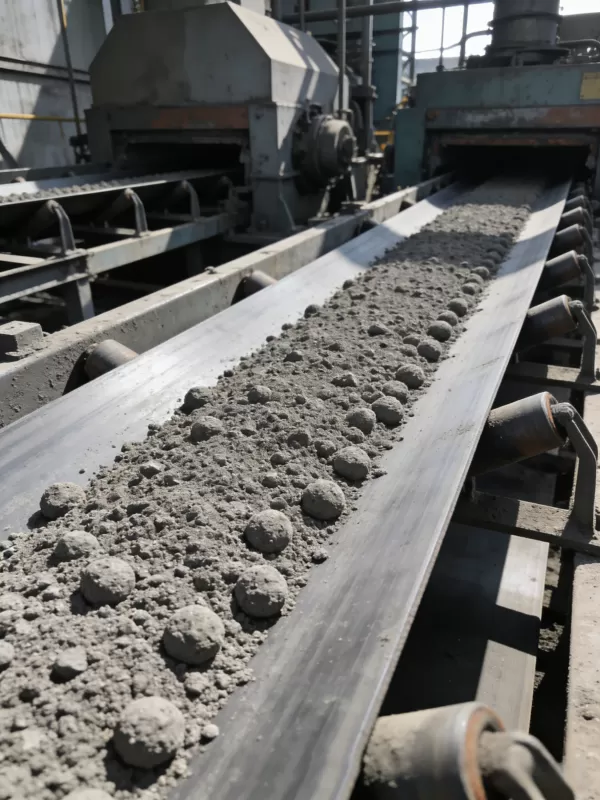
Blast furnaces and direct-reduction iron (DRI) plants require uniform, spherical feedstocks rather than loose iron ore dust. The iron ore pelletizing sector utilizes sodium bentonite as a core bonding agent during wet processing.
Fine magnetite or hematite concentrates are mixed with a controlled dose of sodium bentonite (typically 0.5% to 1.2% by weight). The mix is then rolled inside rotating discs or drums to form green (unfired) pellets.
Bentonite provides distinct mechanical benefits throughout this process:
Green Pellet Strength: Wet pellets survive transfer points, conveyor belts, and drop chutes without deforming or cracking.
Dry Compressive Strength: During the preheating stage, moisture evaporates rapidly. Sodium bentonite keeps the pellet structure intact, preventing dust generation inside the induration furnace.
Thermal Shock Resistance: High-grade clay raises the bursting temperature of the pellets, preventing structural failure as moisture turns to steam.
Steelmakers monitor gangue mineral inputs closely. Sourcing a high-yield bentonite allows mills to lower their overall clay dosage. This reduces excess silica ($SiO_2$) and alumina ($Al_2O_3$) in the furnace feed, keeping operating costs low.
6. Specialty Industrial and Bulk Consumer Applications
Beyond heavy industry, sodium bentonite serves several high-volume consumer and agricultural product lines. Jinshi processes specialized grades tailored to match exact grain distributions and liquid absorption criteria for these markets.
Clumping Cat Litter: Natural sodium bentonite forms the foundation of commercial clumping pet litters. Its fast-absorbing properties trap moisture within seconds, forming solid clumps that are simple to remove. Processors demand strictly controlled granular fractions (1mm to 4mm) with fine dust eliminated via industrial screening.
Agricultural Carriers: Coarse bentonite granules work exceptionally well as stable carriers for fertilizers, pesticides, and soil amendments. The clay remains chemically inert, holds active chemicals securely, and disintegrates smoothly when exposed to field rain.
Procurement Verification: How to Read a COA and TDS
Securing consistent material quality requires industrial buyers to look past marketing claims and analyze the supplier's Technical Data Sheet (TDS) and Certificate of Analysis (COA). Standardize your receiving inspection around these essential parameters:
Montmorillonite Purity: Insist on XRD (X-ray diffraction) confirmation showing at least 70% to 80% montmorillonite. Avoid blends bulked up with quartz, cristobalite, or feldspar.
Moisture Content: Factory output should measure between 8% and 12%. Overly dry clay hydrates too slowly, while moisture levels above 13% invite clumping during storage.
Mesh Size Distribution: Wet-sieve testing confirms your grind size. Drilling and foundry grades typically require 95% passing through a 200-mesh screen (75 microns).
Free Swell Volume: Verify swell volume using the standard ASTM D5890 test. Pure natural sodium clay will routinely test at or above 24 mL per 2 grams of sample.
Logistics and Moisture-Proof Packaging
Bentonite is an active desiccant that pulls moisture directly from the surrounding air. Bulk ocean shipping across humid shipping routes can ruin unsealed product before it ever reaches the destination port.
Containerized 25kg Bags: Multi-wall kraft paper bags must include an internal heat-sealed polyethylene (PE) plastic liner. Bags must be shrink-wrapped and palletized securely.
1 to 1.2 Metric Ton Jumbo Bags: Bulk bags (FIBCs) require woven polypropylene fabric coated with moisture barriers. Bottom discharge spouts speed up site handling during high-volume drilling or foundry operations.
Frequently Asked Questions (FAQ)
Q1: What is the main difference between natural sodium bentonite and
activated sodium bentonite?
A1: Natural sodium bentonite features
geological sodium ions in its interlayer structure, providing durable swelling
and high thermal stability. Activated bentonite is calcium clay treated with
soda ash. Activated grades produce high initial viscosity, but their bonds can
break down under heat, salinity, or high mechanical shear.
Q2: Which API specification applies to sodium bentonite for drilling
fluids?
A2: Drilling-grade bentonite falls under API Specification
13A. Section 9 covers standard industrial bentonite, while Section 10 governs
high-purity, untreated natural bentonite intended for critical drilling
operations.
Q3: How much sodium bentonite is required to seal a commercial pond
or reservoir?
A3: Application rates depend entirely on native soil
porosity. Sandy soils generally require 3 to 5 pounds per square foot, while
coarse gravels may need 6 to 8 pounds or more. Soil testing before installation
confirms the correct dosage.
Q4: Why is sodium bentonite preferred over calcium bentonite in iron
foundries?
A4: Sodium bentonite provides higher wet tensile strength
and retains its crystal lattice under extreme heat. Calcium bentonite loses its
binding capabilities at lower temperatures, meaning foundries must add more
fresh clay to every processing cycle.
Q5: How do I test the swelling volume of sodium bentonite
on-site?
A5: Use the ASTM D5890 testing method. Dry and pulverize a
bentonite sample, then add 2.0 grams into a 100 mL graduated cylinder filled
with distilled water in 0.1-gram increments. Wait 24 hours and record the
hydrated volume. High-grade sodium bentonite will swell to at least 24 mL.
Source Certified Sodium Bentonite for Your Facility
Understanding diverse sodium bentonite uses helps engineering teams cut consumption rates, protect equipment, and streamline site operations. Sourcing your materials from a proven mineral processor ensures predictable chemistry, high purity, and dependable logistics across every batch.
Jinshi supplies high-grade natural sodium bentonite to drilling, foundry, and civil engineering operations worldwide. Contact our technical sales division today to request your Certificate of Analysis, arrange a free laboratory testing sample, or get a competitive bulk quotation on your next shipment.