
Enhancing Seal Integrity and Rheology Control with High-Purity Natrium Bentonite
2026-06-23
Industrial manufacturing and civil engineering operations rely on high-performing raw materials to maintain structural integrity and processing efficiency. Among these specialized mineral resources, natrium bentonite stands out as a highly versatile sodium-rich clay mineral valued for its distinct rheological, swelling, and binding capabilities. This mineral is utilized across global industries, including oil and gas drilling, civil construction, foundry castings, and consumer products such as clumping cat litter. Choosing a reliable processing partner is important to ensure consistent physical and chemical properties in bulk shipments.
Jinshi specializes in the processing and supply of graded clay minerals, delivering raw materials that meet strict industrial specifications. By maintaining direct control over sourcing and milling operations, the variation in raw clay attributes is minimized, allowing global buyers to receive predictable material performance. Understanding the underlying mineralogy and functional mechanisms of this natural sodium clay is key to selecting the right grade for specific industrial tasks.
Mineralogical Structure and Hydration Swelling Mechanisms
The primary mineral constituent of natrium bentonite is montmorillonite, a three-layer clay mineral classified under the smectite group. Structurally, montmorillonite consists of an octahedral alumina sheet sandwiched between two silica tetrahedral sheets, forming a 2:1 phyllosilicate structure. Isomorphous substitution within this crystal lattice, such as the replacement of aluminum ions by magnesium ions in the octahedral layer, creates a net negative charge across the clay platelets. In natural sodium-dominant clays, this negative charge is balanced by exchangeable sodium ions located within the interlayer spacing.
When exposed to moisture, these sodium ions hydrate, drawing water molecules directly into the interlayer spaces. The relatively weak electrostatic forces between the layers, combined with the high hydration energy of the sodium cations, allow the crystal sheets to separate. This crystalline swelling can expand the dry clay up to 15 to 20 times its original dry volume, creating a highly viscous, gel-like structure even at low solid-to-liquid concentrations. Unlike calcium-dominant bentonite, which displays limited hydration due to the stronger binding forces of divalent calcium ions, the sodium-dominant variety provides maximum swelling volume and superior gel strength.
This structural expansion also establishes highly effective barriers against fluid migration. As the clay platelets expand within a confined space, they form an interlocking, low-permeability matrix. This mechanical seal relies heavily on the quality and distribution of the sodium ions within the montmorillonite layers. Sourcing refined natrium bentonite ensures that the material achieves its full hydration potential, which is highly valued in fluid loss prevention and soil sealing applications.
Key Industrial Applications and Performance Profiles
Drilling Fluids and Slurry Wall Construction
In the drilling and civil construction sectors, high-yielding clay is required to formulate functional drilling muds and excavation slurries. When mixed with water, natrium bentonite forms a thixotropic suspension that exhibits shear-thinning behavior. Under shear stress, such as during pumping or drill bit rotation, the viscosity decreases to allow smooth fluid circulation. When the stress is removed, the fluid rapidly reverts to a gel state, suspending drill cuttings and preventing them from settling at the bottom of the borehole.
The swelling clay also coats the porous walls of the borehole, depositing a thin, low-permeability filter cake. This physical barrier prevents the loss of fluid into the surrounding geological formations and maintains hydrostatic pressure to prevent borehole collapse. For these civil engineering tasks, the clay must meet specific standards, such as those established by the American Petroleum Institute (API), ensuring consistent filtrate loss control and yield point values.
Geosynthetic Clay Liners and Environmental Containment
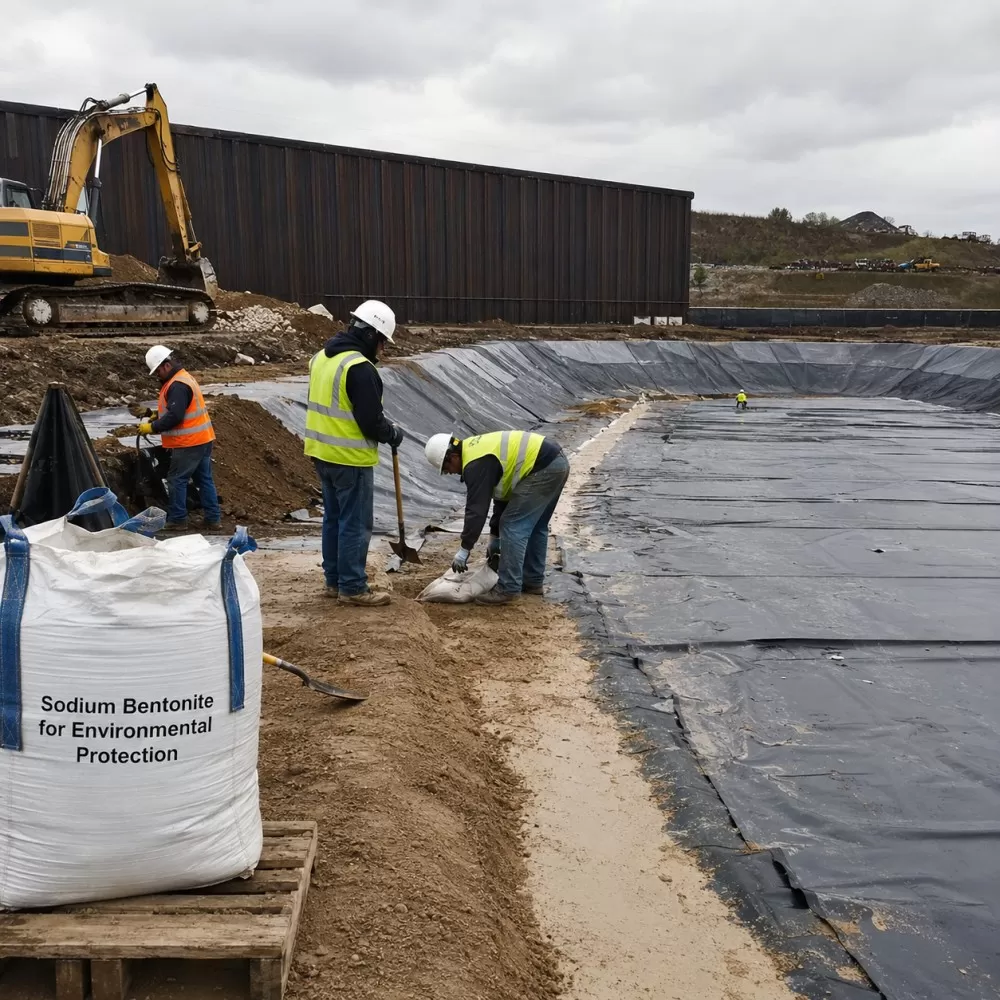
Environmental protection and waste containment designs rely heavily on the low hydraulic conductivity of swollen sodium clay. Geosynthetic Clay Liners (GCLs) utilize a layer of natrium bentonite needle-punched between geotextile layers to create robust hydraulic barriers. These liners are widely used in landfill base systems, mining tailing ponds, and municipal water reservoirs to prevent contaminants from leaching into surrounding groundwater systems.
The self-healing capability of this clay is particularly valuable in containment applications. If a puncture or minor structural shift occurs within the liner, the highly active sodium clay adjacent to the breach hydrates and swells into the void, sealing the damage and maintaining barrier integrity. This long-term hydraulic performance depends on preserving a high montmorillonite content and avoiding excess non-swelling minerals like quartz or feldspar during processing.
Foundry Sand Binder in Green Sand Casting
Metal casting foundries utilize sodium-rich bentonite as a binding agent in green sand molding mixtures. The clay is blended with silica sand and water to coat individual sand grains, providing the cohesive strength required to form stable molds. The mold must withstand the thermal stress and physical pressure of molten metal pouring without losing its shape or eroding.
Using natrium bentonite provides superior green compression strength and hot shear strength compared to calcium bentonite. This heat resistance ensures that the mold retains its dimensional accuracy during the pouring phase, minimizing casting defects such as scabs, swells, and washouts. The high thermal stability of the sodium clay allows for a higher rate of sand reclamation and reuse within the foundry loop, supporting process efficiency.
Premium Clumping Cat Litter Manufacturing
In the pet care manufacturing sector, the moisture-absorbing and clumping properties of natural sodium bentonite are highly valued. When used in cat litter, the material quickly absorbs moisture to form flat, firm clumps that can be easily separated from the remaining dry litter. This rapid absorption locks in liquid and limits the spread of odors without the need for synthetic chemical additives.
Jinshi supplies raw materials with optimized particle size distributions to ensure fast agglomeration and minimal dust generation during handling. Controlling the moisture content during the drying phase prevents premature hydration, ensuring that the finished consumer product maintains its high absorption capacity and structural integrity during shipping and long-term storage.
Addressing Common Procurement Challenges in Clay Sourcing
Industrial purchasing departments often face challenges related to material consistency and quality variation when sourcing bulk clay minerals. Variations in montmorillonite content, cation exchange capacity (CEC), and particle size distribution can disrupt manufacturing lines and lead to operational inconsistencies. For instance, a drop in the swelling index of the clay used in a GCL production line can result in finished products failing to meet strict permeability specifications.
Another operational challenge involves the presence of non-clay minerals, specifically crystalline silica (quartz) and abrasive grit. High grit levels can cause excessive wear on processing machinery, slurry pumps, and mixing equipment, leading to frequent maintenance shutdowns and equipment replacement. Sourcing materials from processors with advanced screening and separation systems helps protect downstream equipment from premature mechanical wear.
Logistical management of bulk clay shipments is also a consideration, as variations in raw material moisture levels can affect both shipping costs and handling qualities. Clay that is too wet can clump in storage silos and resist dry blending, while clay that is too dry can generate excessive dust during transfer operations. Jinshi addresses these logistical concerns by utilizing controlled drying and milling processes to deliver consistent moisture levels tailored to the client's handling systems and packaging specifications.
Processing Standards and Quality Parameters at Jinshi
To ensure consistent raw material performance, Jinshi implements rigorous evaluation steps throughout the processing cycle. From deposit selection through crushing, drying, milling, and packaging, key physical and chemical metrics are tracked and verified. These standard assessments help confirm that the shipped natrium bentonite aligns with international procurement standards.
Swell Index (ASTM D5890): Verifies the volumetric expansion of 2 grams of clay in deionized water, targeting a minimum value of 24 mL/2g for high-grade applications.
Fluid Loss Control (API Spec 13A): Measures the volume of filtrate released under pressure, ensuring the clay forms an effective barrier in drilling mud systems.
Methylene Blue Value (MBV): Measures the active montmorillonite clay content within the raw material, indicating its overall cation exchange capacity.
Moisture Content: Regulated within a specific range, typically 8% to 12%, to balance shipping weight, dust control, and dispersibility during compounding.
Grit Content (Wet Sieve Analysis): Limits residue retained on a 75-micron (200 mesh) wet sieve, preserving downstream mixing equipment and ensuring smooth slurry textures.
By conducting these standard analytical checks, Jinshi maintains uniform batch quality, enabling manufacturers to run production lines with predictable raw material inputs. This commitment to physical consistency supports reliable outcomes in civil works, foundry operations, and consumer product manufacturing alike.
Frequently Asked Questions (FAQ)
Q1: What is the main structural difference between natrium bentonite and calcium bentonite?
A1: The main difference lies in the dominant exchangeable cation within the interlayer space of the montmorillonite structure. Natrium bentonite contains exchangeable sodium ions, which allow for high water absorption and extensive crystalline swelling. Calcium bentonite contains exchangeable calcium ions, which exhibit lower hydration energy, resulting in significantly lower swelling and lower gel strength when mixed with water.
Q2: Can calcium bentonite be converted into sodium bentonite?
A2: Yes, calcium bentonite can undergo a process known as sodium activation. This chemical exchange involves treating the calcium clay with a sodium salt, typically sodium carbonate (soda ash). While this process improves the swelling index and viscosity of the clay, naturally occurring natrium bentonite generally displays more stable long-term rheological performance and thermal durability in demanding industrial settings.
Q3: How does moisture content affect the shelf life and storage of bulk clay?
A3: Bulk clay must be stored in dry, weather-proof silos or moisture-resistant packaging to prevent premature hydration. If exposed to high humidity or direct water, the clay will absorb atmospheric moisture, reducing its swelling capacity for final use and causing caking or flow issues within storage systems. When stored correctly in dry environments, the mineral retains its properties indefinitely.
Q4: Why is the methylene blue test important for evaluating clay quality?
A4: The methylene blue test is used to measure the cation exchange capacity of the clay sample, which correlates directly with the active montmorillonite content. Because raw bentonite deposits naturally contain inactive minerals like quartz, calcite, and gypsum, the methylene blue test helps determine the actual concentration of active, swelling clay platelets in the processed material.
Q5: What mesh sizes are typical for industrial clay applications?
A5: Sizing is tailored to the specific application. For drilling fluids and GCL manufacturing, fine powders milled to 200 mesh (75 microns) or 325 mesh (45 microns) are standard to ensure rapid hydration and dispersion. For foundry green sand and pet litter applications, granular formats with larger particle sizes are preferred to manage dust and control the rate of moisture absorption.
Submit Your Specifications for Custom Clay Formulations
Sourcing raw materials with the correct specifications is vital for maintaining the efficiency and quality of your industrial processes. Jinshi offers tailored processing options to meet your exact requirements for particle size distribution, moisture levels, swelling index, and rheological properties.
We invite you to submit an inquiry with your detailed material specifications. Our technical team is available to assist you in selecting the ideal grade, coordinating bulk logistics, and providing consistent material solutions for your manufacturing or civil engineering projects.