
6 Key Performance Criteria for Evaluating Granular Bentonite for Sale in Bulk Quantities
2026-07-22
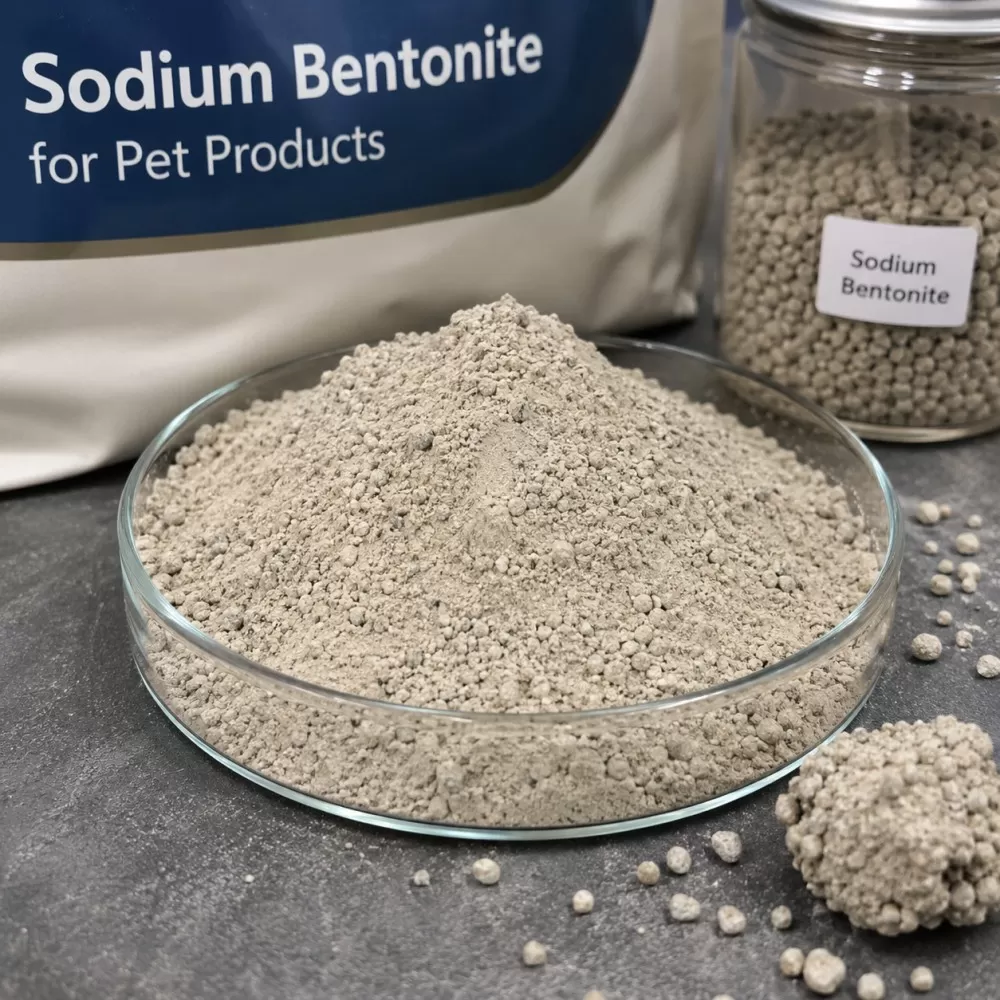
Bentonite clay remains one of the most versatile non-metallic mineral commodities in global manufacturing and environmental engineering. Composed primarily of montmorillonite—a 2:1 expandable smectite clay mineral—bentonite exhibits distinct physical properties including high cation exchange capacity, pronounced hydration swelling, thixotropic gel formation, and substantial surface area absorption. When processed into controlled particle sizes, granular bentonite for sale provides significant operational advantages over fine powders, particularly regarding dust reduction, flowability, and controlled dispersion rates across automated systems.
Selecting appropriate mineral reserves and processing specifications directly impacts operational yields in applications ranging from absorbent cat litter formulations to geo-environmental containment barriers and foundry casting binders. Industrial buyers evaluating commercial supplies must analyze underlying mineralogy, sodium-to-calcium ratios, particle size distribution curves, and structural integrity to ensure raw materials meet rigorous performance parameters. As an integrated miner and processor, Jinshi manufactures structured clay products designed to solve specific operational challenges in heavy industry and commercial absorbent markets.
Mineralogical Fundamentals and Structural Chemistry
The core behavior of bentonite stems from the crystal structure of montmorillonite. Each layer consists of an aluminum-magnesium octahedral sheet sandwiched between two silicon-oxygen tetrahedral sheets. Isomorphous substitution within this lattice—where trivalent aluminum ions replace tetravalent silicon, or divalent magnesium ions replace trivalent aluminum—creates a net negative structural charge across the clay sheets. This structural imbalance is neutralized by interlayer exchangeable cations, primarily sodium ($\text{Na}^+$) or calcium ($\text{Ca}^{2+}$).
The identity of these interlayer cations dictates how the granular material hydrates and swells when exposed to aqueous solutions:
Sodium Bentonite: Contains naturally dominant sodium cations. When hydrated, water molecules penetrate deep into the interlayer spaces, forcing the crystalline plates apart in a phenomenon known as osmotic swelling. This allows sodium bentonite to expand up to 15 to 20 times its original dry volume, creating a low-permeability barrier with high plastic viscosity.
Calcium Bentonite: Dominantly features divalent calcium cations. Due to the stronger electrostatic attraction of divalent charges, water absorption is limited to crystalline swelling, resulting in lower volume expansion (typically 2 to 5 times dry volume). However, calcium bentonite possesses superior structural rigidity, fast initial fluid absorption, and effective acid-activation characteristics.
Sodium-Activated Bentonite: Produced by treating natural calcium bentonite with sodium carbonate (soda ash) through mechanical shearing and controlled hydration. This ion-exchange process swaps calcium cations for sodium ions, providing expanded swelling capabilities while maintaining the dense particle strength of the source material.
Understanding these mineralogical characteristics allows procurement managers to select the exact dynamic properties required for their processing plant, avoiding premature hydration or structural breakdown during conveyance.
Key Industrial Applications and Performance Requirements
Different commercial sectors demand precise physical and chemical profiles from raw clay materials. Sourcing granular bentonite for sale requires aligning mesh sizes and mineral properties with specific end-use environments.
Pet Care and Absorbent Granules
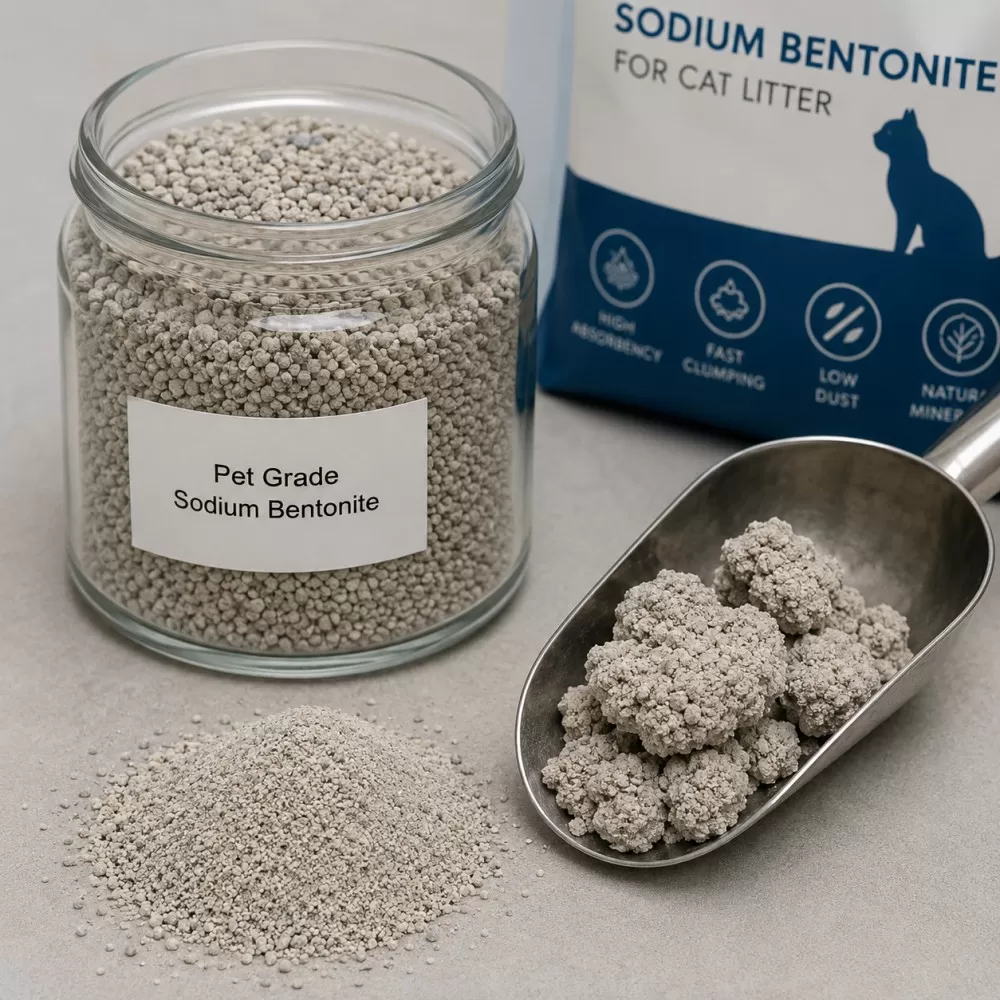
In modern commercial pet care, granular bentonite forms the foundation of high-performance clumping cat litter. The material relies on rapid capillary action to pull moisture inside the aggregate bed, followed by rapid lattice swelling that binds adjacent granules into solid, coherent clumps. Key quality metrics for this application include:
Particle Size Range: Typically targeted between 1.0 mm and 4.0 mm (equivalent to 5 to 18 mesh). Fine particles cause excessive dust, whereas overly coarse particles reduce total available surface area, resulting in weak, crumbling clumps.
Clump Mass Strength: Measured in peak force load. High-quality bentonite forms dense clumps that withstand mechanical screening and bucket removal without breaking apart.
Odor Retention: Natural inter-layer micro-cavities trap volatile nitrogen compounds (such as ammonia), preventing gas release without relying heavily on artificial chemical masking agents.
Civil Engineering and Geo-Environmental Barriers
Within geotechnical construction, granular bentonite serves as the primary sealing mechanism in Geosynthetic Clay Liners (GCLs), slurry trench cut-off walls, and borehole sealants. When hydrated under confinement, the expanding clay fills void spaces between adjacent structural media, yielding hydraulic conductivity values lower than $1 \times 10^{-9} \text{ cm/s}$.
For these heavy engineering applications, granular forms are preferred over fine powders because they distribute evenly across carrier geotextiles and prevent localized erosion during installation. Controlled particle breakdown guarantees uniform hydration rates without generating voids or thin spots in protective liners.
Foundry Sand Binding and Metal Casting
In green sand mold casting, granular bentonite acts as a high-temperature binder that holds silica sand grains together under extreme thermal and mechanical shear. The clay must retain its plastic bonding strength under molten metal temperatures exceeding $1200^\circ\text{C}$.
Foundry operations focus on green compression strength, dry compression strength, and thermal durability (the percentage of active clay that retains swelling capabilities after repeated heating cycles). Granular delivery systems allow automated sand systems to meter binder additives without excessive loss to environmental dust collection systems.
Agriculture and Soil Conditioning
Coarse bentonite granules are incorporated into coarse sand soils to increase Water Holding Capacity (WHC) and prevent rapid nutrient leaching. The high surface area and Cation Exchange Capacity (CEC)—often exceeding $70 \text{ meq}/100\text{g}$—allow the clay to retain applied ammonium, potassium, and trace elements, releasing them slowly to root systems over extended growth cycles.
Manufacturing and Granulation Processing at Jinshi
Producing consistent, high-specification clay granules requires careful material preparation and precise physical processing. Jinshi manages production through controlled processing phases designed to preserve structural performance while minimizing internal particle stress.
Raw Deposit Extraction and Weathering
Raw clay is systematically extracted from selected high-montmorillonite geological strata. Following extraction, the crude ore undergoes field aging and sun-drying. Natural weathering balances initial moisture levels, breaks down tough clay aggregates, and promotes uniform ion diffusion across the mineral matrix.
Activation and Extrusive Granulation
For activated sodium grades, precise quantities of high-purity sodium carbonate are blended into the crude clay at calibrated moisture levels. The mixture passes through heavy-duty industrial extruders or double-shaft mixers. High mechanical shear forces soda ash into the interlayer spaces, driving effective cation exchange between sodium and calcium ions.
Drying, Crushing, and Multi-Deck Screening
Following activation or initial processing, the clay enters rotary fluid-bed dryers where temperatures are kept below structural dehydration thresholds (typically under $150^\circ\text{C}$) to preserve the natural crystal lattice. Once dried to target moisture limits (typically 8% to 12%), the material enters roller crushers configured to produce specific yield sizes.
Multi-deck vibrating screens isolate distinct particle fractions. Material larger than the upper threshold returns to the crushing loop, while sub-mesh dust is pulled off by negative-pressure air classifiers. Jinshi utilizes closed-loop screening circuits to ensure precise particle distribution curves with minimal fine residue.
Dust Control and Surface Conditioning
To reduce attrition dust during shipping and bulk handling, finished granules pass through air-wash dedusting towers. In specialized pet care or industrial applications, low-concentration anti-dust processing aids or functional coatings may be applied to improve granule mechanical strength and flow characteristics.
Technical Specification Comparison
Evaluating commercial grades requires reviewing standard testing values. The table below illustrates core parameters across different functional grades of granular clay materials offered by Jinshi:
| Parameter / Metric | Pet Care Grade | Civil Engineering / GCL Grade | Foundry Binding Grade |
|---|---|---|---|
| Montmorillonite Content | $\ge 75\%$ | $\ge 80\%$ | $\ge 70\%$ |
| Predominant Cation | Activated $\text{Na}^+$ / Natural $\text{Ca}^{2+}$ | Natural or Activated $\text{Na}^+$ | Activated $\text{Na}^+$ |
| Particle Size Range | 1.0 mm – 3.5 mm (5–18 mesh) | 0.5 mm – 2.0 mm (10–35 mesh) | 0.2 mm – 1.0 mm (18–70 mesh) |
| Free Swell Volume | $\ge 16 \text{ mL}/2\text{g}$ | $\ge 24 \text{ mL}/2\text{g}$ | $\ge 18 \text{ mL}/2\text{g}$ |
| Moisture Content | $6\% - 10\%$ | $8\% - 12\%$ | $7\% - 11\%$ |
| Bulk Density | $850 - 980 \text{ kg/m}^3$ | $900 - 1050 \text{ kg/m}^3$ | $800 - 950 \text{ kg/m}^3$ |
| Water Absorption (Enslin-Neff) | $\ge 300\%$ | $\ge 500\%$ | $\ge 400\%$ |
Quality Assessment Protocols for Procurement
Bulk industrial purchasers must verify consistency across shipments to avoid downstream disruptions in automated batching plants. Establishing standard testing procedures helps verify that incoming shipments conform to structural specifications.
Particle Size Distribution (PSD) Analysis
Granule size distribution directly controls bulk density, void spaces, and dissolution speeds. Ro-Tap sieve testing determines retention percentages across set mesh openings. A narrow size distribution profile minimizes product segregation during pneumatic transport and long-distance ocean shipping.
Free Swell Index (ASTM D5890)
This standard test measures the swelling capacity of clay materials. Two grams of dried, finely ground clay are introduced into a 100 mL graduated cylinder of deionized water in small increments. After settling for 24 hours, the swollen volume is recorded in milliliters. High-grade sodium bentonite consistently demonstrates values above $24 \text{ mL}/2\text{g}$.
Water Absorption and Hydration Kinetics
Using an Enslin-Neff apparatus or gravimetric cup testing, technicians measure the rate and total volume of liquid absorbed by a dry sample over fixed intervals (e.g., 1 minute, 5 minutes, 2 hours). Fast initial uptake combined with high absolute saturation indicates strong performance for liquid containment and spill remediation applications.
Attrition Resistance and Friability
Granules must withstand handling forces without crumbling into fine dust. Attrition testing measures the percentage of fine particles produced after subjecting a sample to controlled mechanical agitation inside a sealed drum. Low friability scores ensure the material maintains structural integrity inside commercial silos and packaging systems.
Logistics, Bulk Packaging, and Storage Parameters
Managing non-metallic mineral supply chains requires protecting inventory from ambient moisture and contamination during long-distance shipping. When sourcing granular bentonite for sale, bulk buyers must consider available packaging options and handling systems.
Flexible Intermediate Bulk Containers (FIBC Super Sacks): Ranging from 1000 kg to 1250 kg capacity, these woven polypropylene bags feature inner polyethylene liners or laminated fabrics to prevent humidity absorption. They can be configured with bottom discharge spouts for direct connection to industrial hopper systems.
Small Paper and Polypropylene Bags: 20 kg to 25 kg multi-wall valve bags are ideal for retail packing or small-batch manual dosing. High-strength valve bags prevent air entrapment and improve pallet stacking stability.
Bulk Vessel and Pneumatic Tanker Shipments: For high-volume environmental construction projects or industrial plants with integrated silo infrastructure, loose bulk transport offers lower packaging overhead. However, ambient air humidity must be strictly monitored during load-out.
Storage facilities should maintain clean, elevated, dry conditions with intact vapor barriers. Direct ground placement or exposure to atmospheric condensation can initiate localized surface hydration, leading to cake formation inside bulk storage units.
Sourcing Solutions from Jinshi
Navigating technical requirements, mineral specifications, and bulk logistics requires a reliable processing partner. Jinshi maintains direct control over high-purity clay reserves, modern extrusive activation plants, and automated screening circuits. By customizing particle size distribution, swell indices, and bulk densities, Jinshi supports industrial clients across global commercial sectors.
Contact the technical engineering team at Jinshi to submit performance parameters, request lab analysis reports, or coordinate test samples tailored to your processing operations.
Frequently Asked Questions
Q1: What is the main operational difference between fine powder and
granular bentonite?
A1: Granular bentonite offers superior
flowability, reduced airborne dust, and easier handling in bulk feeding systems.
While fine powders hydrate almost instantly, granular particles hydrate
progressively from the outer surface inward, preventing rapid surface sealing
and allowing deeper liquid penetration into absorbent beds or soil
structures.
Q2: How does sodium activation alter calcium bentonite
properties?
A2: Sodium activation uses sodium carbonate and
mechanical shearing to replace interlayer calcium ions with sodium ions. This
process significantly increases the clay's free swell volume, water absorption
capacity, and gel strength, elevating low-swelling calcium bentonite to
performance levels suitable for high-viscosity applications.
Q3: What mesh sizes are recommended for cat litter
manufacturing?
A3: The standard particle size for clumping cat
litter ranges from 1.0 mm to 3.5 mm (5 to 18 mesh). Some specialized
formulations blend coarse particles (2.0–3.5 mm) with fine aggregates (0.5–1.5
mm) to optimize aggregate packing density, speed up clumping times, and increase
clump breaking strength.
Q4: Why is moisture control critical during packaging and
storage?
A4: Bentonite clay is highly hygroscopic and readily
absorbs atmospheric moisture. If internal moisture levels exceed 12% before use,
individual granules can soften, aggregate together, or lose absorption
efficiency, leading to caking in storage silos and reduced overall hydration
performance.
Q5: Can Jinshi process customized particle size distributions for
specific industrial needs?
A5: Yes. Jinshi operates flexible
screening and crushing circuits that can be adjusted to produce specific
particle size profiles. Whether your application requires narrow fraction
distributions for specialized filter media or broad particle distribution curves
for environmental liners, processing lines can be calibrated to meet your exact
specifications.
Q6: How is product quality verified before export
shipment?
A6: Every production batch undergoes standardized
laboratory testing, including X-ray fluorescence (XRF) for mineral composition,
sieve analysis for particle distribution, free swell testing, moisture
evaluation, and bulk density measurement. Quality control certificates are
issued with each batch to confirm compliance with agreed technical
standards.