
3 Methods for Installing Bentonite Pond Clay in Commercial Water Reservoirs
2026-07-09
Water retention is one of the oldest challenges in civil engineering, agriculture, and industrial water management. When constructing agricultural reservoirs, wastewater treatment basins, decorative lakes, or irrigation canals, the underlying soil structure determines whether the water remains contained or slowly drains into the deeper aquifers. Sandy, silty, or highly porous soils allow water to bypass standard containment barriers, leading to continuous water loss, increased operational expenses, and structural instability. While synthetic membranes like High-Density Polyethylene (HDPE) or ethylene propylene diene monomer (EPDM) offer one path forward, they are vulnerable to mechanical punctures, UV degradation, and high installation costs.
A natural, permanent alternative relies on the mineral properties of bentonite pond clay. This natural, sodium-rich volcanic ash deposit offers a self-healing barrier that integrates directly with existing soil structures, creating an impermeable layer that lasts for the lifetime of the pond. Jinshi supplies high-grade natural sodium bentonite processed for large-scale sealing applications, providing a reliable option for engineers, agricultural managers, and municipal developers who require reliable water containment solutions.
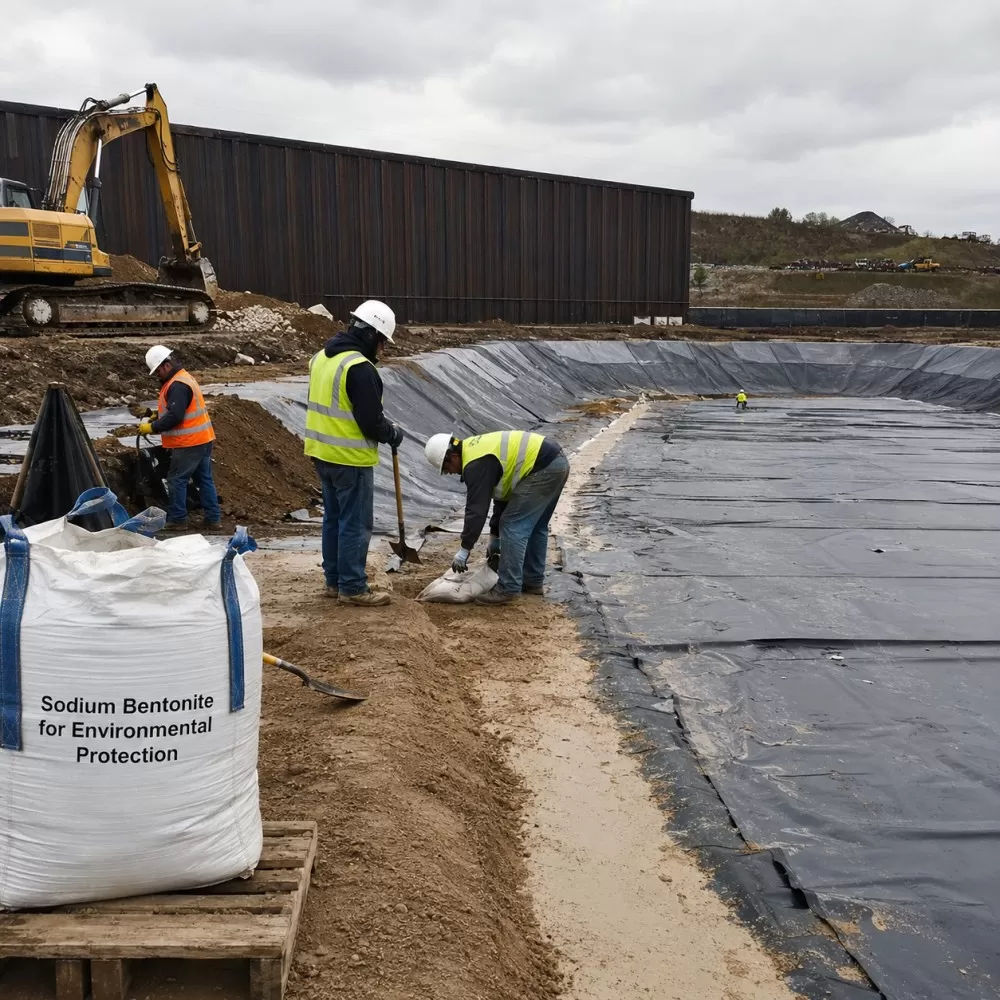
Understanding the Mineralogy of Bentonite Pond Clay
To evaluate the effectiveness of bentonite pond clay, one must analyze its mineralogical structure. Unlike standard construction clays, bentonite is primarily composed of montmorillonite, a soft phyllosilicate group mineral. The crystalline structure of montmorillonite consists of an octahedral sheet of alumina sandwiched between two tetrahedral sheets of silica. This 2:1 layer structure carries a negative electrical charge, which is balanced by exchangeable cations, primarily sodium ions in high-swelling bentonite variations.
When water molecules come into contact with these interlayer spaces, the sodium ions attract water through hydration forces, causing the crystal lattices to expand. High-quality sodium bentonite can absorb several times its dry weight in water, swelling up to 12 to 15 times its original dry volume. This swelling capability creates a dense, gel-like mass with extremely low hydraulic conductivity, often measured at less than 1 x 10^-9 centimeters per second. Calcium bentonite, by contrast, has much lower swelling potential due to the divalent calcium ions holding the clay platelets more tightly together, making sodium-rich bentonite pond clay the preferred choice for sealing water retention structures.
How Bentonite Seals the Soil Matrix
The sealing mechanism relies on pore space clogging within the soil matrix. When dry bentonite pond clay is introduced to porous soils, it fills the empty spaces between sand grains and gravel particles. As moisture enters the system, the clay expands within these voids. The expanding gel exerts lateral pressure against the surrounding soil particles, compressing the remaining micro-voids.
This process transforms a highly permeable soil into a cohesive, impermeable barrier. Unlike synthetic membranes, which fail completely if punctured by a rock, tree root, or wildlife, this natural clay barrier exhibits self-healing properties. If a puncture or tear occurs, the surrounding hydrated clay shifts and expands into the newly created void, resealing the breach. This property makes the material highly reliable in dynamic soil environments where shifting or settling occurs over time.
Selecting the Right Grade for Commercial Projects
A successful installation requires evaluating the existing soil composition. Sandy loam, clean sand, and gravel require different treatment strategies. Conducting a basic soil analysis, such as a sieve analysis and a plasticity index test, allows engineers to determine the exact quantity of bentonite pond clay needed per square foot.
Highly porous soils, such as clean sand, require a higher concentration of clay to achieve a complete seal. In contrast, clayey soils that already have moderate water retention capabilities require minimal addition. Standard application rates typically range from 2 pounds per square foot for silty soils to over 5 pounds per square foot for highly porous gravelly soils.
The physical form of the clay must also match the application method. Powdered bentonite (typically 200 mesh) provides rapid hydration and is ideal for mixing directly into dry soils. Granular bentonite (often 8 to 30 mesh) is less dusty, hydrates more slowly, and is preferred for situations where wind drift is a concern during dry application or when treating minor leaks through standing water. Jinshi offers both graded granules and finely milled powders to suit diverse engineering specifications.
Standard Application Methods for Large-Scale Ponds
Implementing a permanent seal involves distinct methodologies depending on whether the pond is under construction or already contains water.
The Blanket Method
This approach is widely regarded as the most reliable installation technique for dry pond basins.
Excavate the pond basin to a depth roughly six inches deeper than the planned final grade, removing rocks, tree roots, and large debris.
Smooth and compact the subgrade to establish a firm, uniform foundation.
Apply the dry bentonite pond clay evenly across the floor and slopes using a fertilizer spreader or similar equipment, ensuring the specified application rate is maintained.
Carefully cover the clay layer with a six-inch protective blanket of clean, cohesive soil or gravel to hold the clay in place and prevent it from eroding or drying out when exposed to air.
Compact the final soil layer to ensure maximum density.
The Mixed-Blanket Method
When soil conditions allow, mixing the clay directly into the native soil provides a robust, integrated barrier.
Prepare the basin by removing debris and rough grading the area.
Distribute the dry clay uniformly over the surface area at the calculated rate.
Use a rototiller, disc harrow, or soil stabilizer to blend the clay thoroughly with the top four to six inches of native soil.
Compact the blended layer using a sheep's-foot or smooth-drum roller to achieve optimum moisture-density conditions.
Apply a protective layer of gravel or native soil over the compacted zone to shield it from wave action and drying cycles.
The Sprinkle Method
For existing ponds experiencing minor seepage where draining is impractical, the sprinkle method can be used as a targeted remedy.
Identify the general area where seepage is occurring, often indicated by wet spots on the downstream side of a dam or rapidly dropping water levels.
Broadcast granular bentonite over the water surface directly above the suspected leak zone.
Allow the dense granules to sink to the bottom of the pond, where they settle in the intake points of the seepage pathways.
As the granules absorb water, they expand within the cracks and voids on the pond floor, slowly reducing the flow of escaping water. This method is less predictable than dry installation and is best reserved for localized repairs.
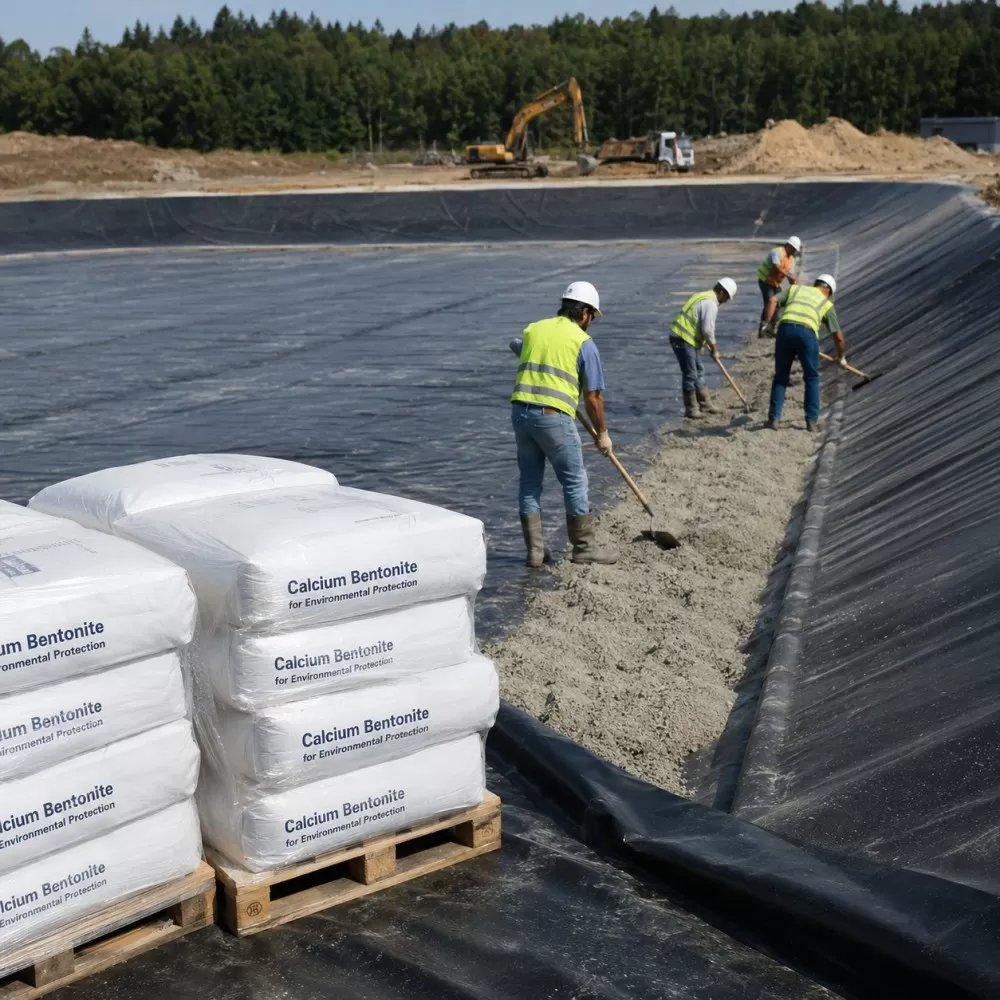
Quality Control Metrics for B2B Procurement
For large agricultural, industrial, or municipal projects, procuring consistent, high-quality raw materials is vital to meeting engineering specifications. Variations in montmorillonite content, moisture levels, and particle size can lead to uneven hydration and localized failure points in the clay liner.
Jinshi addresses these concerns through strict quality control protocols at our production facilities. Our natural sodium bentonite pond clay undergoes rigorous testing to verify its swelling capacity, free swell index, and fluid loss characteristics. We ensure that every batch delivered meets or exceeds standard industry parameters, such as a minimum free swell of 20 milliliters per 2 grams of dry clay. By offering bulk transport options, including super sacks and dry bulk pneumatic tankers, Jinshi supports large-scale infrastructure projects with predictable logistics and reliable material performance.
Frequently Asked Questions
Q1: What is the recommended application rate for bentonite pond clay?
A1: The application rate depends on the underlying soil texture. Clean, coarse sand or gravelly soils generally require between 3 and 5 pounds per square foot. Sandy loams or silty clays can be sealed with lower rates, typically between 1.5 and 2.5 pounds per square foot. A professional soil analysis is recommended to determine the precise requirements for your project.
Q2: How does water chemistry affect the performance of sodium bentonite?
A2: Sodium bentonite achieves its highest swelling capacity in fresh, low-salinity water. High levels of dissolved calcium, magnesium, or sodium chloride in the water can inhibit the hydration process by replacing the sodium ions in the clay's interlayer space, which reduces the overall swelling volume. If your pond contains saline or brackish water, specialized modified clays may be required.
Q3: Can bentonite pond clay seal a pond that is already full of water?
A3: Yes, using the sprinkle method with granular clay can address minor leaks in filled ponds. However, this method is significantly less reliable than dry-basin installation. When clay is dropped through standing water, it is difficult to ensure uniform coverage, and underwater currents can disperse the material. For major leaks, draining the pond and applying a compacted clay liner is the recommended approach.
Q4: Is the clay liner safe for livestock, fish, and aquatic plants?
A4: Natural sodium bentonite is completely non-toxic and chemically inert. It does not introduce harmful synthetic chemicals, plasticizers, or heavy metals into the aquatic ecosystem. It is entirely safe for koi, game fish, livestock, and aquatic vegetation, making it an environmentally sound choice for agricultural reservoirs and natural swimming ponds.
Q5: What is the expected lifespan of a bentonite clay pond liner?
A5: Unlike synthetic liners that eventually degrade due to UV exposure, oxidation, or mechanical wear, bentonite pond clay is a natural mineral that does not decompose over time. As long as the clay layer remains hydrated and is protected by a sufficient layer of soil cover to prevent erosion and physical disruption, the seal will remain effective indefinitely.
Commercial Inquiry and Consultation
Selecting the appropriate grade of bentonite pond clay and calculating precise application rates are key steps in ensuring the longevity of your containment project. Jinshi provides comprehensive support for B2B buyers, offering detailed material safety data sheets, lab analysis reports, and customized logistics solutions for global shipping. To request a quotation for bulk quantities, secure product samples, or discuss your project's specific soil parameters with a materials specialist, please submit your inquiry through our commercial contact portal.