
High-Yield Clay Sourcing: How to Buy Sodium Bentonite for Industrial Applications
2026-07-11
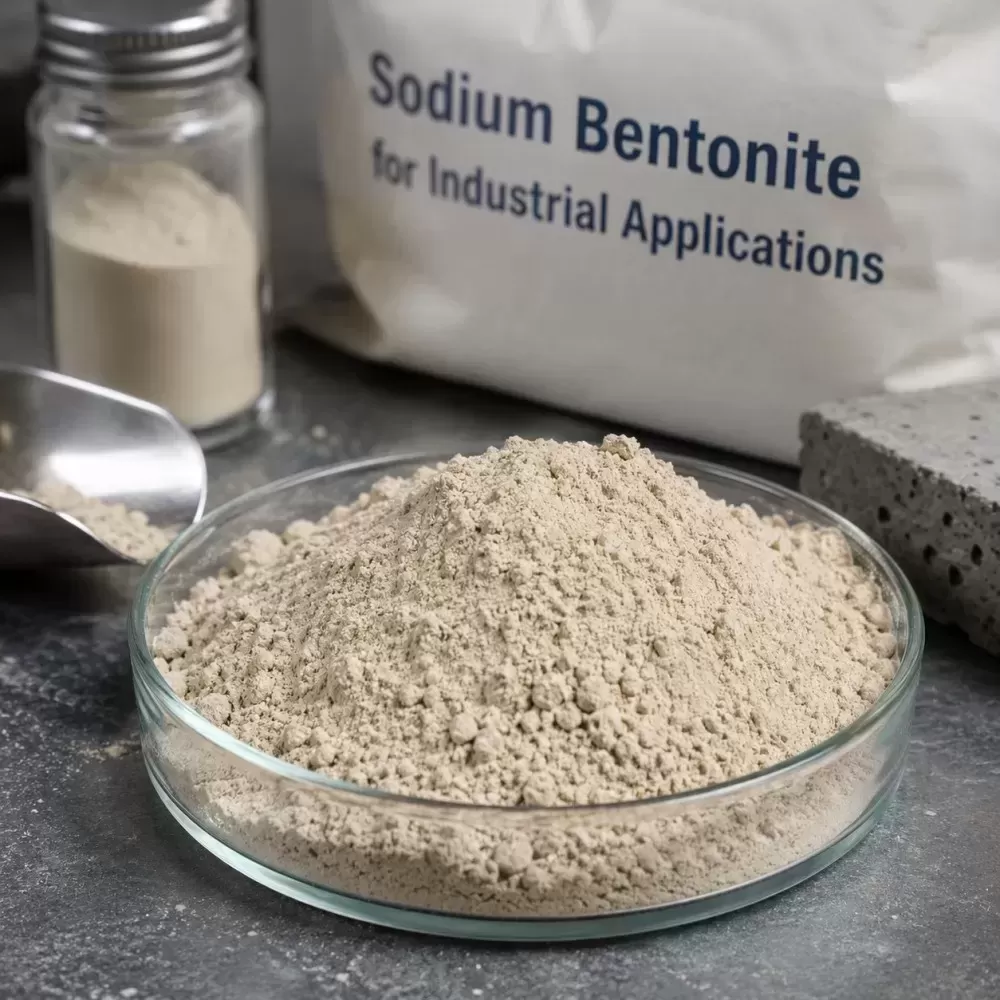
Sodium bentonite is an indispensable natural clay mineral widely recognized for its high swelling capacity, excellent colloidal properties, and superior sealing performance. Characterized by a high concentration of exchangeable sodium ions, this smectite clay absorbs large volumes of water, expanding up to several times its dry volume to form an impermeable gel barrier. For procurement managers and industrial operators looking to buy sodium bentonite, understanding the specific mineral properties and grading systems is necessary to secure consistent performance across various applications.
As a major industrial mineral supplier, Jinshi provides high-purity clay solutions tailored to meet stringent international standards. Selecting the right grade of bentonite involves looking beyond unit costs and analyzing the structural chemistry of the deposit. This evaluation ensures that the raw material performs predictably under challenging industrial conditions.
1. Mineralogical Composition and Quality Standards
The functional value of sodium bentonite stems from its primary constituent, montmorillonite, a three-layer aluminosilicate mineral. The crystalline structure consists of an octahedral alumina sheet sandwiched between two tetrahedral silica sheets. The quality of the clay deposit determines how effectively these layers hydrate and expand when exposed to moisture.
Cation Exchange Capacity (CEC) and Montmorillonite Content
Measured in milliequivalents per 100 grams (meq/100g), CEC indicates the clay's ability to exchange ions with surrounding fluids. High-quality natural sodium bentonite typically exhibits a CEC between 70 to 100 meq/100g. This parameter directly governs the clay's hydration behavior and thermal stability. When organizations plan to buy sodium bentonite for heavy industrial use, verifying the CEC profile helps ensure that the material will maintain its structural integrity under thermal or chemical stress.
Swelling Index and Gel Strength
The swelling volume, usually reported in milliliters per 2 grams of clay, serves as a primary indicator of hydration capacity. Premium grades exceed 24 ml/2g. This swelling potential is what makes the clay an effective water barrier. When the clay particles hydrate, they swell and fill the void spaces within surrounding soils or aggregates, creating a highly cohesive seal with extremely low hydraulic conductivity.
2. Key Industrial Applications and Performance Metrics
Industrial buyers must align their raw material specifications with the target application to prevent operational failures. Different industries require distinct physical characteristics from their clay inputs.
Drilling Fluids and API Specifications
In oil, gas, and geothermal drilling, sodium bentonite serves as a primary viscosifier in water-based drilling fluids. It aids in suspending drill cuttings, sealing the borehole wall to prevent fluid loss, and cooling the drill bit. Buyers should verify compliance with API Specification 13A (American Petroleum Institute) standards, which mandate specific suspension properties, plastic viscosity, and yield points. Proper viscosity ensures the drill cuttings are brought to the surface efficiently without overloading the pumping equipment.
Civil Engineering and Geosynthetic Clay Liners (GCL)
In geotechnical applications, the material forms the active component of geosynthetic clay liners (GCLs). It provides low hydraulic conductivity, preventing the migration of contaminants from municipal landfills or industrial waste containment areas. The low permeability ensures that liquid waste is securely isolated. For civil engineering projects, granular grades are often preferred to control dust and manage hydration speed during installation.
Metal Casting and Foundry Sand Binder
The metal casting industry relies on sodium bentonite to bond silica sand molds. The clay provides high green compression strength, dry strength, and thermal durability, allowing the mold to withstand the high temperatures of molten metal without collapsing or causing surface defects on the casting. Consistent clay bonding properties directly influence the surface finish and structural integrity of the cast metal parts.
3. Common Supply Chain Challenges in Bentonite Sourcing
Procuring mineral resources often presents challenges related to raw material variability and logistics. Natural clay deposits vary in purity, moisture content, and mineral composition from one vein to another.
Excessive moisture in raw shipments increases transportation costs and causes clumping during storage. Conversely, over-drying the clay during thermal processing can damage the montmorillonite structure, permanently reducing its swelling capacity. Jinshi implements strict drying protocols, maintaining a balanced moisture level (typically between 8% and 12%) that preserves mineral activity while facilitating handling.
Because clay is a high-bulk, heavy commodity, shipping logistics play a significant role in overall procurement costs. Strategic sourcing partners must offer reliable packaging options, such as multi-wall paper bags or heavy-duty bulk bags (super sacks), alongside robust shipping networks to prevent moisture ingress during maritime transit.
4. How to Evaluate Suppliers When You Buy Sodium Bentonite
To secure a stable supply of clay materials, industrial buyers should implement a rigorous vetting process for potential manufacturers. This helps maintain consistent production schedules and product quality.
Quality Assurance Laboratories: A reliable supplier must maintain on-site laboratory facilities to perform regular testing of montmorillonite content, moisture levels, grit content, and rheological properties. Buyers should request a Certificate of Analysis (COA) for every batch.
Customization Capabilities: Different projects require specific particle size profiles and activation levels. Suppliers like Jinshi offer tailored grinding and modification services, ensuring that the delivered material matches the exact engineering requirements of the project.
Sourcing Stability: Partnering with a manufacturer that controls its mining deposits ensures long-term price stability and consistent chemical characteristics, reducing the occurrence of sudden formulation changes in downstream production.
5. Standard Testing Methods for Procurement Verification
Before finalizing a contract to buy sodium bentonite, purchasing teams should familiarize themselves with standard laboratory tests used to verify quality. Relying solely on visual inspection is insufficient for verifying mineral performance.
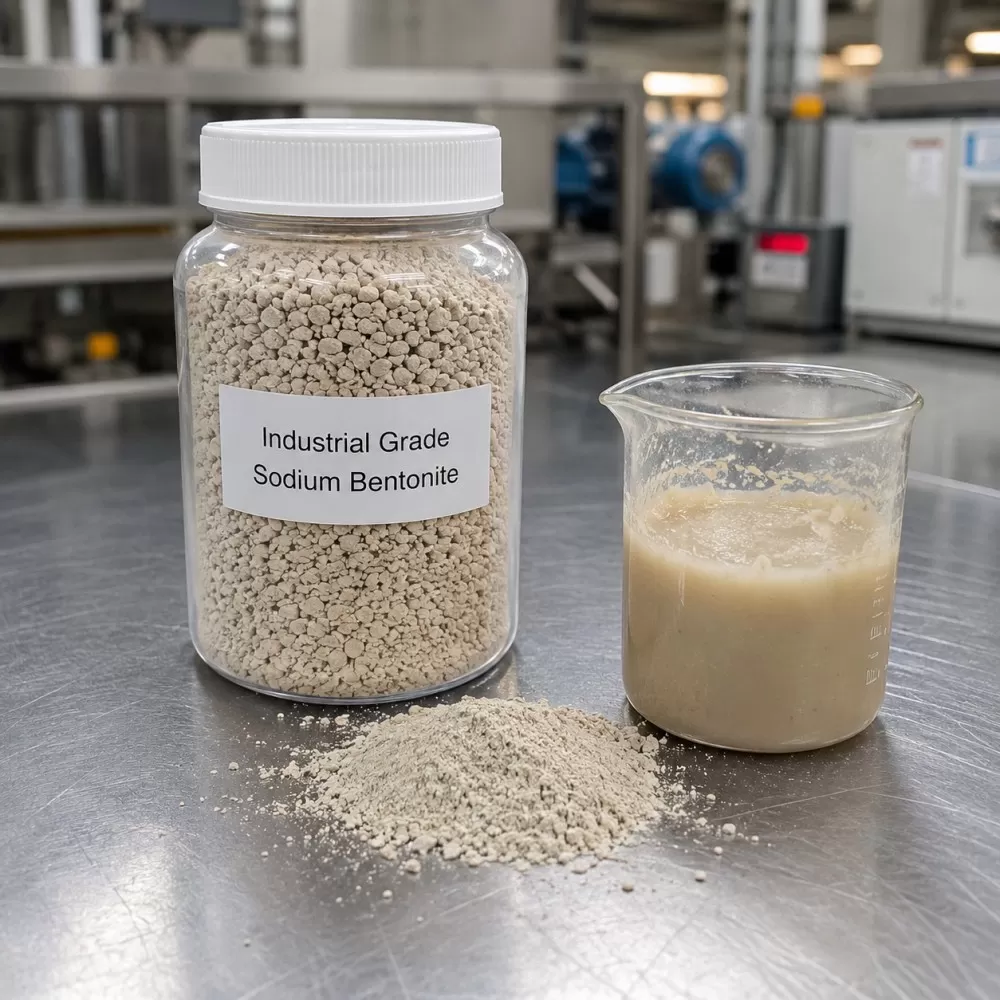
The methylene blue absorption test determines the actual montmorillonite content within the clay sample, distinguishing active clay from inert minerals like quartz or feldspar. Viscosity testing via a Fann viscometer measures the plastic viscosity and yield point of a 6% clay-water suspension, which is standard for drilling fluid evaluations. Fluid loss testing measures the volume of water filtered through a clay cake under pressure, indicating how effectively the clay will seal porous formations in the field.
Frequently Asked Questions
Q1: What is the main difference between sodium bentonite and calcium
bentonite?
A1: Sodium bentonite contains sodium as
the predominant exchangeable cation, giving it high swelling capacity and gel
strength. Calcium bentonite contains calcium ions, resulting in much lower
swelling and different colloidal properties, making it more suitable for
clarifying oils rather than sealing or viscosifying.
Q2: How does moisture level affect the shelf life of sodium
bentonite?
A2: When stored in a dry, cool warehouse
in its original sealed packaging, sodium bentonite has an almost indefinite
shelf life. However, exposure to moisture during storage can lead to premature
hydration, clumping, and a reduction in handling efficiency during mixing.
Q3: What are the typical packaging options for large-scale industrial
buyers?
A3: Industrial clay is typically supplied
in 25 kg multi-wall paper bags or 1,000 kg to 1,200 kg bulk bags (jumbo bags).
Bulk shipments in pneumatic tankers are also available for regional projects
with dedicated storage silos.
Q4: How do I verify if a batch complies with API 13A
standards?
A4: Compliance can be verified by
reviewing the Certificate of Analysis (COA) provided by the supplier. Key
parameters tested under API 13A include 600 rpm dial reading, yield point to
plastic viscosity ratio, filtrate volume, and wet residue (grit content)
remaining on a 75-micrometer screen.
Q5: Can sodium bentonite be customized for specific drilling
conditions?
A5: Yes, manufacturers can adjust the
formulation by adding specific polymers or treating the clay to enhance thermal
stability or salt tolerance, which is helpful when drilling through saline
formations or high-temperature zones.
Sourcing High-Grade Clay Solutions
Industrial operations require dependable mineral inputs to maintain efficiency and product quality. For detailed product specifications, custom packaging options, or to request a sample for laboratory evaluation, please submit your specifications to our industrial sales team at Jinshi. We are prepared to assist with your specific application requirements and provide comprehensive logistics support for global distribution.