
Maximizing Process Efficiency with High-Yield Granular Sodium Bentonite Clay
2026-07-01
Industrial minerals serve as the foundation for modern manufacturing, environmental engineering, and consumer product formulation. Among these resources, granular sodium bentonite clay stands out due to its distinct physical and chemical characteristics. Derived from volcanic ash deposits matured over millions of years, this natural phyllosilicate mineral is defined by its high concentration of montmorillonite. The mineral's layered crystalline structure and high cation exchange capacity make it a valuable commodity for diverse industrial sectors globally. Companies like Jinshi focus on processing this raw material to meet precise industry specifications, ensuring consistent performance across various supply chains.
Understanding the performance of this material requires an examination of its mineralogical characteristics, mechanical behavior, and processing pathways. Selecting the correct grade of clay affects product quality, operational safety, and overall process efficiency. This article examines the structural mechanics of granular sodium bentonite clay, identifies common operational challenges in its application, and outlines its primary roles in consumer goods, civil engineering, and industrial operations.
The Mineralogical and Chemical Structure of Sodium Bentonite
The operational value of granular sodium bentonite clay is directly linked to its atomic structure. Montmorillonite, the primary mineral component, consists of an octahedral alumina sheet sandwiched between two tetrahedral silica sheets, commonly referred to as a 2:1 layer structure. These layers carry a net negative electrical charge, which is balanced by exchangeable cations located in the interlayer spaces. In sodium bentonite, sodium ions ($Na^+$) serve as the dominant exchangeable species, differing from calcium-dominant bentonite variations.
This specific chemical arrangement yields several distinct characteristics:
High Hydration Capacity: When exposed to moisture, water molecules are drawn into the interlayer spaces, causing the crystalline lattice to expand. This swelling capability allows the clay to absorb several times its dry weight in water.
Cation Exchange Capacity (CEC): The high negative charge density enables the clay to bind and exchange heavy metals and organic compounds, making it highly effective for filtration and purification processes.
Thixotropic Properties: When dispersed in water, the clay forms a non-Newtonian fluid that behaves as a gel under static conditions but flows as a liquid when agitated, which is a key property in civil engineering slurry applications.
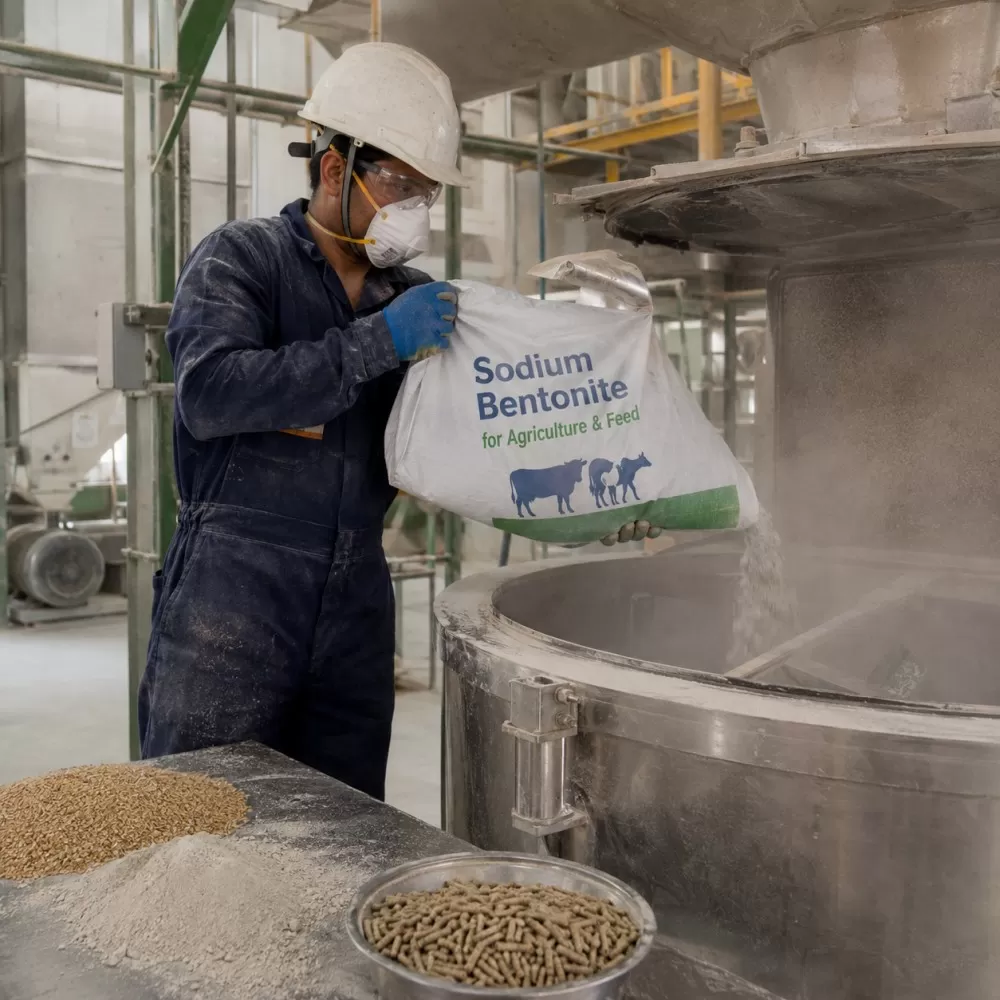
To meet the demands of global industries, Jinshi processes the raw ore into specific granular forms. Granulation reduces dust, improves handling characteristics, and controls the rate of hydration, ensuring the material remains manageable during bulk transportation and mechanical feeding.
Physical Performance Metrics and Quality Standards
When sourcing granular sodium bentonite clay for industrial use, procurement teams and quality control engineers evaluate specific physical parameters to verify process compatibility. Standardized testing methodologies, such as those established by the American Society for Testing and Materials (ASTM), are routinely employed to assess batch consistency.
The primary physical metrics analyzed during quality assurance include:
Swell Index: Typically measured in milliliters per two grams of dry clay (ml/2g), high-grade sodium bentonite generally exhibits a swell index exceeding 20 ml/2g. This indicates the expansion volume of the material when fully hydrated in distilled water.
Particle Size Distribution (PSD): The distribution of granule sizes determines the surface area exposure and hydration rate. For applications like pet litter, a balanced PSD prevents product segregation and optimizes compaction.
Moisture Content: Raw clay contains variable moisture levels. Controlled drying processes at processing facilities maintain the moisture content within a strict 6% to 12% range to prevent premature clumping and microbial activity during storage.
Bulk Density: This metric influences silo storage design, packaging dimensions, and freight calculations. Standard granular grades typically range from 800 to 1,000 kg/m³.
Maintaining these parameters requires strict process controls during mining, drying, crushing, and screening. Variations in the geological deposit must be managed through precise blending practices before granulation to deliver a uniform end product to industrial buyers.
Addressing Common Operational Challenges in Bulk Clay Handling
Industrial processors often encounter specific difficulties when integrating bulk minerals into automated production lines. Fine powders generate excessive dust, which creates respiratory hazards for plant operators, increases mechanical wear on machinery, and leads to product loss. Utilizing granular sodium bentonite clay partially addresses these issues, but operational adjustments are still necessary to maintain productivity.
Material attrition during pneumatic transport is a common issue. If the granules are too fragile, they break down into fines during high-velocity conveying. Processing facilities must focus on the mechanical strength of the granules to ensure they resist degradation during transit, packaging, and silo discharge.
Moisture control in storage facilities is another key factor. Because of its hydrophilic nature, the clay readily absorbs atmospheric moisture. Standard warehousing protocols require dry, climate-controlled storage environments and heavy-duty, moisture-barrier packaging, such as woven polypropylene jumbo bags with internal polyethylene liners, to prevent premature hydration and caking.
Granular Sodium Bentonite Clay in Cat Litter Formulations
The pet care industry represents one of the largest global markets for granular sodium bentonite clay. Cat litter manufacturers utilize this material primarily for its rapid clumping behavior and natural odor absorption properties. When liquid contacts the granules, they hydrate quickly, swell, and bind adjacent particles to form a solid, cohesive clump that is easily separated from the remaining dry litter.
The Mechanics of Clump Formation
Clump strength is determined by the speed of hydration and the inter-particle cohesive forces of the clay. When liquid is introduced, the outer layers of the granules swell, creating a low-permeability barrier that retains the liquid within a localized zone. This localized clumping prevents moisture from seeping to the bottom of the litter tray, mitigating bacterial growth and simplifying cleanup. Manufacturers often adjust the particle size distribution to balance absorption speed with clump stability, preventing the clumps from breaking apart during mechanical scooping.
Odor Control and Dust Control
The molecular structure of sodium bentonite plays a role in neutralizing waste odors. The clay's negative surface charge allows it to adsorb ammonium ions ($NH_4^+$), preventing them from converting into volatile ammonia gas. Additionally, the physical encapsulation of moisture within the clump limits the moisture required for odor-producing bacteria to thrive.
To meet consumer expectations for low-dust products, Jinshi utilizes multi-stage screening and dedusting equipment during the final manufacturing steps. This ensures that the granular sodium bentonite clay delivered to packaging lines contains minimal sub-mesh fines, enhancing the consumer experience and reducing respiratory irritation for household pets.
Civil Engineering and Environmental Containment Applications
The low hydraulic conductivity of hydrated sodium bentonite makes it a standard material in geotechnical engineering and environmental protection. When fully hydrated under confined conditions, the clay forms an impermeable barrier that prevents the movement of water, industrial effluents, and contaminants.
Geosynthetic Clay Liners (GCLs)
Geosynthetic clay liners are manufactured by sandwiching a uniform layer of granular sodium bentonite clay between needle-punched geotextiles. These liners are widely used in landfill construction, tailing ponds, and canal linings. The granular form is preferred over fine powder in GCL manufacturing because it distributes more evenly during the needle-punching process and generates less dust on the production floor. If the liner is punctured during installation, the adjacent clay hydrates, expands, and self-heals the breach, maintaining containment integrity.
Slurry Trench Cut-Off Walls
In civil engineering projects where groundwater migration must be controlled, contractors construct slurry trench cut-off walls. A slurry of bentonite and water is pumped into a deep trench during excavation. The hydrostatic pressure of the dense slurry prevents the trench walls from collapsing, while the clay particles deposit onto the trench walls, forming a low-permeability cake that blocks lateral groundwater movement.
Metallurgical and Casting Applications
Foundry operations rely on binding agents to maintain the structural integrity of sand molds during metal casting. In green sand casting, granular sodium bentonite clay is blended with silica sand and water. The clay coats the sand grains, providing the thermal stability and plasticity required to withstand the thermal stress of molten metal.
Key properties required for foundry-grade clay include:
Green Compression Strength: The mold must retain its shape immediately after compaction and during the handling phase before metal pouring.
Dry Compression Strength: As the molten metal heat dries the mold, the sand-clay mixture must resist erosion and deformation.
Thermal Durability: The clay must retain its binding properties through multiple casting cycles, minimizing the need for fresh bentonite additions in recycled sand systems.
By supplying consistent granular sodium bentonite clay, Jinshi helps foundries maintain mold precision, reduce casting defects like scabs or sand inclusions, and optimize sand reclamation systems.
Procurement Considerations and Supply Chain Management
For B2B buyers and raw material procurement managers, sourcing industrial clay requires evaluating more than just the cost per ton. Logistics, packaging options, and quality control systems are key factors in maintaining a stable supply chain.
Geological consistency is the first factor to consider. Clay deposits vary across different strata of the same mine. Sourcing partners must implement strict extraction plans and laboratory testing for each mined batch to ensure the delivered granular sodium bentonite clay maintains consistent swelling, absorption, and particle distribution. Packaging options, ranging from 25kg bags for manual batching systems to 1,000kg jumbo bags for automated bulk systems, must align with the buyer's material handling capabilities.
Frequently Asked Questions
Q1: What is the difference between sodium bentonite and calcium bentonite?
A1: The primary difference lies in the dominant exchangeable cation within the clay's interlayer space. Sodium bentonite features dominant sodium ions, which allow for high hydration capacity, substantial swelling, and excellent gel strength. Calcium bentonite contains dominant calcium ions, which exhibit low swelling capacity and limited gel formation, making it more suitable for chemical catalyst carriers or bleaching clays rather than clumping or sealing applications.
Q2: Why is the granular form preferred over fine powder in industrial processes?
A2: Granular forms are selected to reduce dust generation in the workplace, improve flowability in hoppers and silos, and control the hydration rate. While fine powder hydrates almost instantly and can form blockages or clumps in mixing equipment, granules hydrate more predictably, making them easier to handle in automated processing systems.
Q3: How does moisture level affect the shelf life of granular sodium bentonite clay?
A3: Sourcing clay with controlled moisture levels (typically 6% to 12%) is necessary to prevent pre-gelation or caking during storage. If the moisture is too high, the granules may bond together under the weight of stacked pallets. When stored in a dry, ventilated environment in moisture-resistant packaging, the clay has an indefinite shelf life.
Q4: Can granular sodium bentonite clay be recycled in industrial casting systems?
A4: Yes, in green sand foundry casting, the clay can be recycled through sand reclamation systems. However, repeated exposure to high temperatures gradually degrades the clay's crystalline structure, reducing its swelling capacity over time. Foundries must monitor the active bentonite content and periodically add fresh clay to maintain mold quality.
Q5: How does this material perform in low-temperature or saline environments?
A5: High salinity interferes with the hydration process of sodium bentonite by compressing the electrical double layer around the clay particles, which reduces its swelling index. In environmental containment projects involving saline groundwater, modified or polymer-treated bentonite grades are often required to maintain low hydraulic conductivity.
Inquire About Jinshi Clay Solutions
Selecting the appropriate mineral grade is necessary to maintain product quality and operational efficiency. Jinshi provides processed granular sodium bentonite clay tailored to the specifications of global industrial manufacturers, cat litter producers, and civil engineering firms. To request technical datasheets, material samples, or a commercial quote for your specific application, please submit your detailed requirements through our inquiry portal, and our technical sales team will assist you with product specifications and logistics planning.