
Technical Guide to Sodium Montmorillonite Clay: Properties, Specs & Industrial Uses
2026-08-27
Mineral terminology in the industrial absorbent and rheology sectors often creates operational confusion. Terms like "bentonite," "smectite," and "montmorillonite" are frequently used as interchangeable synonyms across supply chains. While commercial vernacular groups these materials under general classifications, raw material engineers and chemical procurement managers require strict mineralogical and performance distinctions.
Montmorillonite is the active, functional smectite mineral species that grants bentonite rock its unique colloidal, hydration, and rheological properties. Among its various geological variations, sodium montmorillonite clay represents the benchmark for high-swelling, high-viscosity, and high-cation-exchange applications. Understanding the precise crystallographic structure, surface chemistry, and performance metrics of this mineral is essential for optimizing industrial processes ranging from civil engineering to specialized environmental remediation.
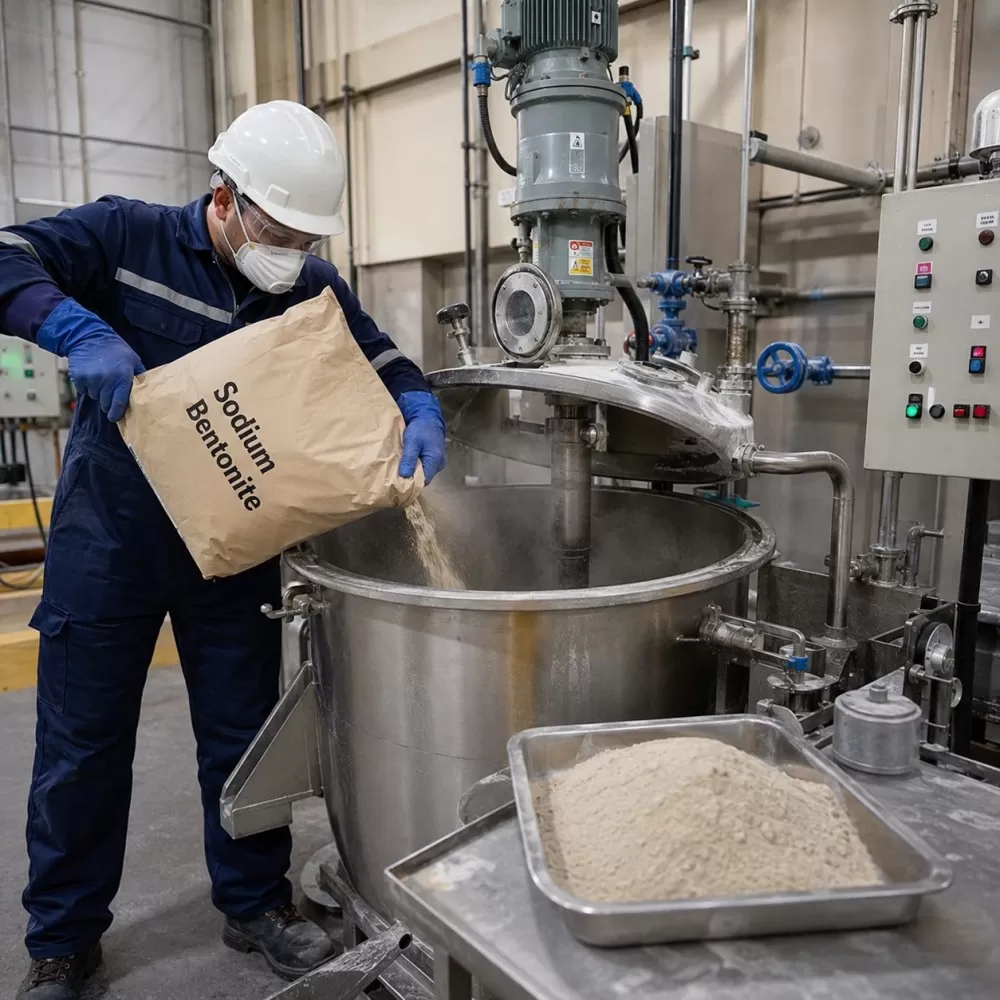
Mineralogical Architecture: What Defines Sodium Montmorillonite Clay?
To understand why sodium montmorillonite clay exhibits unmatched thixotropic and binding capabilities, one must examine its crystallographic lattice. Geologically derived from the diagenetic alteration of volcanic ash in marine environments, montmorillonite belongs to the 2:1 phyllosilicate (smectite) family.
Its microscopic profile consists of an octahedral alumina sheet sandwiched between two inward-pointing tetrahedral silica sheets. This triple-layer sheet structure produces distinct physical and chemical behaviors:
Isomorphous Substitution: During formation, trivalent aluminum ($Al^{3+}$) ions in the central octahedral layer are naturally substituted by divalent magnesium ($Mg^{2+}$) or iron ($Fe^{2+}$) cations without altering the crystal structure. This creates a permanent, lattice-wide net negative electrical charge.
Interlayer Exchangeable Cations: To balance this structural charge deficiency, naturally occurring hydrated cations locate within the interlayer spaces between the 2:1 sheets. In sodium montmorillonite, monovalent sodium ($Na^+$) is the predominant exchangeable interlayer ion.
Specific Surface Area: Due to its lamellar structure and sub-micron particle morphology, high-purity sodium montmorillonite provides an exceptional specific surface area, typically ranging from 700 to 800 m²/g (including internal interlayer and external surface area).
The Mechanism of Hydration and Macromolecular Swelling
The defining characteristic of sodium montmorillonite clay is its ability to expand substantially when exposed to water. Monovalent sodium ions exhibit a large hydrated radius combined with a relatively low charge density compared to multivalent cations like calcium ($Ca^{2+}$).
When water enters the interlayer matrix:
Hydration begins crystalline swelling as polar water molecules align around the exchangeable $Na^+$ cations, pushing the basal spacing ($d_{001}$) from an initial ~1.2 nm to roughly 1.8–2.0 nm.
Continuous hydration shifts the system into osmotic swelling. The concentration gradient between the interlayer region and the bulk fluid forces water between the sheets, overcoming attractive van der Waals forces.
This results in the complete delamination (exfoliation) of individual platelets into colloidal suspensions, creating a rigid, continuous "house-of-cards" thixotropic gel network at low mineral concentrations.
Adsorption vs. Absorption: Surface Mechanics
Industrial applications frequently leverage both sorption mechanisms provided by the mineral:
Adsorption (Electrostatic Binding): The high Cation Exchange Capacity (CEC)—typically 80 to 120 meq/100g—allows the negatively charged sheet surfaces to capture and immobilize positively charged ions, polar organic molecules, heavy metal cations, and mycotoxins onto its immense surface.
Absorption (Physical Entrapment): The expansive interlaminar spaces physically draw in, retain, and lock liquids and suspended colloids via capillary and osmotic mechanics, functioning as an impermeable fluid barrier under confinement.
Sodium Montmorillonite vs. Calcium Montmorillonite: Industrial Comparison
A frequent procurement issue involves distinguishing natural sodium montmorillonite from calcium montmorillonite (calcium bentonite). While both are smectites, their performance profiles diverge significantly due to their distinct interlayer chemistry.
| Technical Parameter | Natural Sodium Montmorillonite | Calcium Montmorillonite | Standardized Test Method |
|---|---|---|---|
| Predominant Interlayer Ion | Monovalent Sodium ($Na^+$) | Divalent Calcium ($Ca^{2+}$) | X-ray Fluorescence (XRF) / ICP-OES |
| Free Swell Index | ≥ 24 – 35 mL / 2g | 2 – 6 mL / 2g | ASTM D5890 |
| Hydration Behavior | Osmotic swelling to complete exfoliation | Limited crystalline swelling only | XRD Basal Spacing ($d_{001}$) |
| Fluid Loss Reduction | High (Forms dense, thin filter cakes) | Low (Porous, permeable filter cakes) | API Spec 13A (Filter Press) |
| Viscosity / Yield Point | Strong pseudoplastic, thixotropic gel | Low viscosity, Newtonian tendencies | Fann Viscometer / Rheometer |
| Thermal Durability | Stable crystalline matrix up to ~500°C | Lower collapse threshold under cyclic heat | Thermogravimetric Analysis (TGA) |
Calcium montmorillonite exhibits strong electrostatic attraction between its divalent calcium ions ($Ca^{2+}$) and adjacent negatively charged silicate sheets. This higher ionic charge density pins the layers tightly together, preventing water molecules from forcing the sheets apart into osmotic swelling. Consequently, calcium-dominant clays cannot produce the high-viscosity suspensions, fluid barrier films, or sealing properties required in heavy civil and drilling operations without extensive chemical activation (soda-ashing).
Key Industrial Applications and Performance Metrics
The high-purity profile of sodium montmorillonite clay makes it a functional raw material across diverse global industries. Below are the primary engineering sectors relying on its physical and chemical properties.
1. Civil Engineering, Drilling, and Slurry Walls
In deep geotechnical engineering, directional drilling (HDD), and diaphragm wall excavation, sodium montmorillonite provides essential fluid mechanics:
Viscosity and Cuttings Transport: Under shear, the fluid thins to ease pumping; when circulation halts, it rapidly sets into a thixotropic gel, suspending dense rock cuttings and preventing tool sedimentation.
Hydrostatic Wall Support: The colloidal particles deposit across porous formations, forming an ultra-low-permeability filter cake that stabilizes borehole walls and minimizes fluid loss to adjacent strata.
Standard Compliance: High-grade products must comply strictly with API Spec 13A or OCMA specifications regarding plastic viscosity, yield point, and filtrate loss volume.
2. Environmental Containment and Geosynthetic Clay Liners (GCL)
Modern landfill infrastructure, tailings dams, and hazardous containment ponds utilize sodium montmorillonite as the primary hydraulic barrier:
Hydraulic Conductivity: When hydrated under confining pressure, the clay achieves hydraulic conductivity values as low as $k \le 1 \times 10^{-9}\text{ cm/s}$, preventing leachate escape into underlying aquifers.
Self-Healing Capacity: If punctured or disturbed, the high swelling volume of sodium montmorillonite allows it to naturally hydrate and seal fissures, preserving the hydraulic seal.
3. Green Sand Foundry Casting
In metal casting, sodium montmorillonite serves as the binder for green sand molds:
Thermal and Compressive Strength: It provides high green compression strength (wet state) and high dry/hot strength to resist the thermal stress and erosion of molten iron and steel pours ($>1400^\circ\text{C}$).
Dimensional Accuracy: Controlled clay coatings prevent sand expansion defects, ensuring tight dimensional tolerances on cast industrial components.
4. Animal Feed Additives & Mycotoxin Remediation
In agricultural production, purity and mineral safety dictate selection:
Aflatoxin Adsorption: Due to its interlayer electrical potential, sodium montmorillonite selectively chemisorbs planar polar mycotoxins (notably Aflatoxin $B_1$) within the gastrointestinal tract, preventing systemic absorption in livestock.
Pellet Binding: Its lubricating and binding properties improve the durability index (PDI) of feed pellets while reducing fines during bulk logistics.
5. Industrial Wastewater Clarification
Modern effluent management requires targeted treatment of complex industrial discharges:
Flocculation and Heavy Metal Removal: Sodium montmorillonite destabilizes emulsified oils, suspends organic residues, and replaces interlayer sodium with heavy metal ions ($Pb^{2+}$, $Cd^{2+}$, $Ni^{2+}$, $Zn^{2+}$) via cation exchange, allowing rapid precipitation.
Quality Control and Specification Criteria for Industrial Procurement
Procuring commercial-grade clay requires strict evaluation beyond basic product data sheets. Low-grade clays blended with non-smectite gangue minerals (e.g., quartz, feldspar, gypsum, cristobalite) fail prematurely under operational stress.
B2B technical buyers should specify and verify the following analytical parameters:
Montmorillonite Mineral Purity: Must be verified via quantitative X-ray Diffraction (XRD) and Methylene Blue (MB) adsorption tests. Industrial grades should maintain a minimum active montmorillonite content of 75% to 90%+.
Natural vs. Activated Sodium: Determine if the material is naturally occurring sodium montmorillonite or soda-activated calcium bentonite (chemically treated with $Na_2CO_3$). Natural sodium clays offer superior thermal stability and long-term durability in critical engineering settings.
Particle Size Distribution: Depending on the application, specify grind profiles ranging from coarse granular (for GCLs and aggregate binders) to 200-mesh/325-mesh fine powders (for drilling, foundries, and chemical formulations).
Trace Heavy Metal Thresholds: For agricultural, animal feed, and pharmaceutical applications, strict ICP-MS batch certifications must verify low baseline limits for Arsenic ($As$), Lead ($Pb$), Cadmium ($Cd$), and Mercury ($Hg$).
Manufacturers like Jinshi apply advanced processing methods, automated desanding, and rigorous laboratory validation across every batch. Consistent raw material properties prevent processing downtime and optimize formulation costs in end-use applications.
Frequently Asked Questions (FAQ)
1. What is the fundamental difference between bentonite and sodium montmorillonite clay?
Bentonite is the industrial geological rock term, whereas montmorillonite is the specific smectite mineral species that delivers functional performance. Sodium montmorillonite clay refers to high-grade bentonite where the active mineral is dominated by montmorillonite containing exchangeable sodium interlayer cations.
2. Can calcium bentonite be converted into sodium montmorillonite?
Yes, through a process known as sodium activation (soda-ashing), where calcium bentonite is treated with sodium carbonate ($Na_2CO_3$). This replaces interlayer $Ca^{2+}$ with $Na^+$. However, artificially activated clays often exhibit lower thermal stability and may experience cation reversion in saline environments compared to natural sodium montmorillonite.
3. Why is Cation Exchange Capacity (CEC) critical when sourcing this mineral?
CEC measures the total quantity of exchangeable cations that a clay can hold at a given pH. A higher CEC (above 80–100 meq/100g) confirms high mineralogical purity, superior toxin/heavy metal binding capacity, and stronger swelling and rheological performance.
4. How does salinity impact the performance of sodium montmorillonite?
High ionic strength or salinity in hydration fluids (such as calcium-rich or saline groundwater) suppresses the electrical double layer around the clay platelets. This inhibits osmotic swelling, reduces viscosity, and increases fluid loss. In such environments, specialized polymer-treated or crosslinked clay formulations are required.
5. What standardized methods verify the quality of sodium montmorillonite?
Key testing standards include ASTM D5890 for Free Swell Index, ASTM D5891 for Fluid Loss, API Specification 13A for drilling grade rheology and filtrate, and Methylene Blue titration for active smectite content determination.
Source Certified Industrial Sodium Montmorillonite Clay from Jinshi
Consistent process performance relies on verified raw material chemistry. Jinshi is a premier global manufacturer and bulk supplier of high-purity sodium montmorillonite clay, engineered to meet demanding technical standards for civil construction, foundry operations, environmental containment, and custom industrial manufacturing.
We provide full-spectrum batch traceability, accredited third-party lab testing (XRD, XRF, API 13A, ASTM), and customized particle sizing to match your exact formulations. Contact our engineering and technical sales team today to request comprehensive product data sheets (TDS), safety documentation (MSDS), and industrial pilot samples.